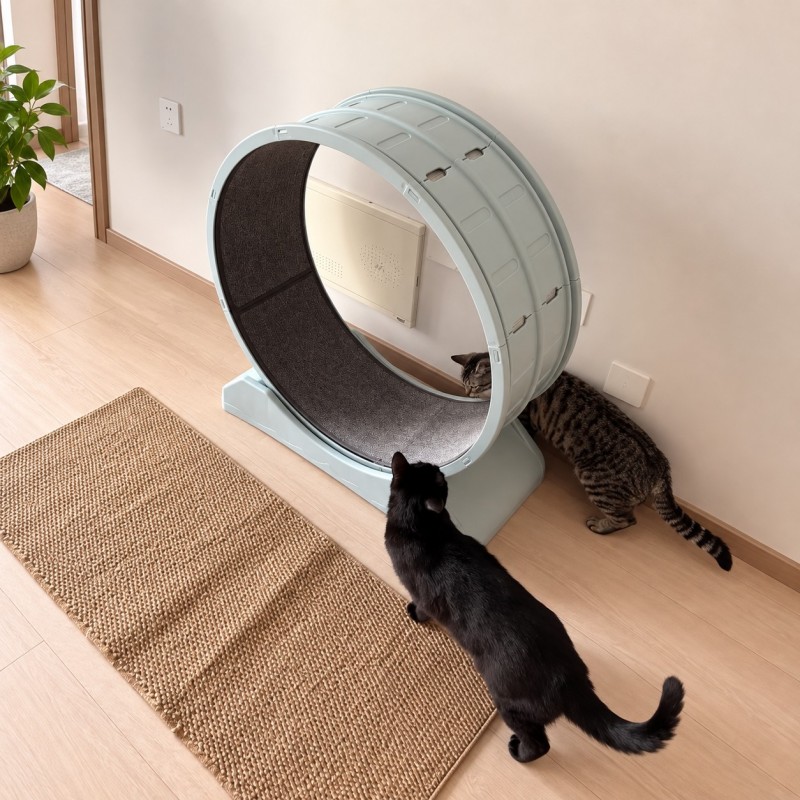
The best cat exercise wheel is not automatically the biggest or most expensive model.
A good wheel has to fit the cat, the room, and the way the product will actually be used. Inner diameter, running width, stability, tread grip, assembly, replacement parts, and noise all matter.
In 2026, sellers should also watch one clear product direction: modular plastic cat exercise wheels.
Our current market scan shows molded-plastic wheels appearing across both specialty products and newer mass-market listings. Some use ABS; a growing number use PP plastic. The commercial logic is clear: lighter structures, faster assembly, easier cleaning, rounded molded geometry, replaceable parts, and knock-down packaging.
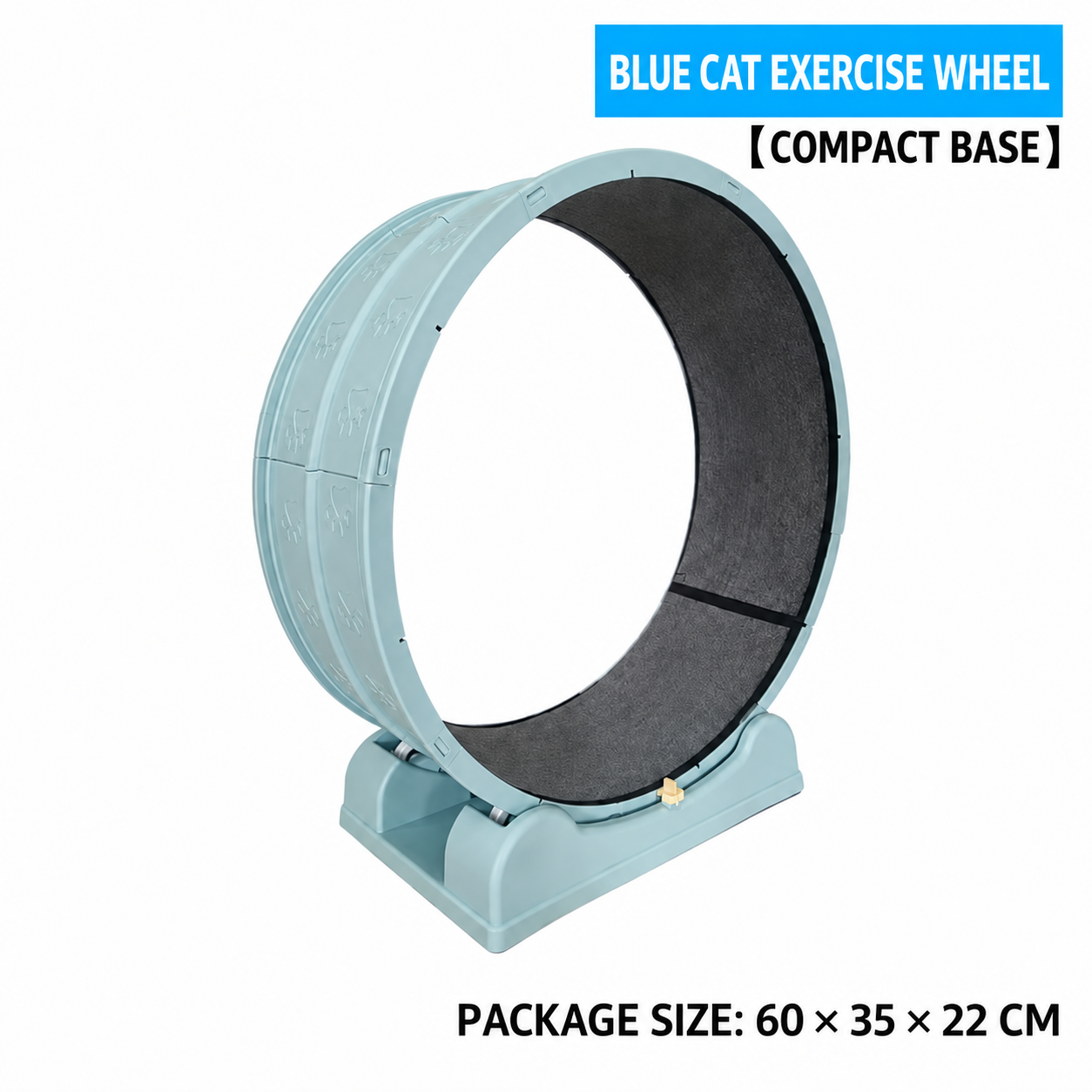
Plastic is not automatically better than wood in every situation. But for sellers building a scalable indoor-cat range, PP deserves serious attention.
Start With the Cat, Not the Material
A cat exercise wheel is an optional enrichment tool, not a requirement for every indoor cat.
Indoor cats still need movement, play, scratching, resting, and choice. A good environment should support natural physical and emotional needs rather than rely on one device.
A University of Illinois study also found that some cats increased voluntary wheel activity after habituation, while others did not respond the same way.
Sellers should therefore avoid “every cat will love it” claims.
Why PP Plastic Is Becoming a Stronger Cat-Wheel Trend
Polypropylene is one of the lightest common thermoplastics, with density around 0.90 g/cm³. It is widely used for injection molding and offers useful chemical and fatigue resistance. PP’s low density and processing flexibility are highly relevant to a large indoor product that must be moved, cleaned, assembled, and shipped.
Easier to Move
A molded PP ring can be lighter than a thick wood or board structure of similar size. Final weight still depends on the base, ribs, rollers, and hardware.
For pet owners, lower mass makes repositioning easier.
For sellers, it can simplify warehouse handling, returns, and after-sales service.
Easier Modular Assembly
PP is well suited to injection molding. ASTM D5857 covers polypropylene materials used for injection-molding and extrusion applications.
That allows designers to create curved sections, snap-fit connectors, locating tabs, integrated ribs, and standardized replacement panels.
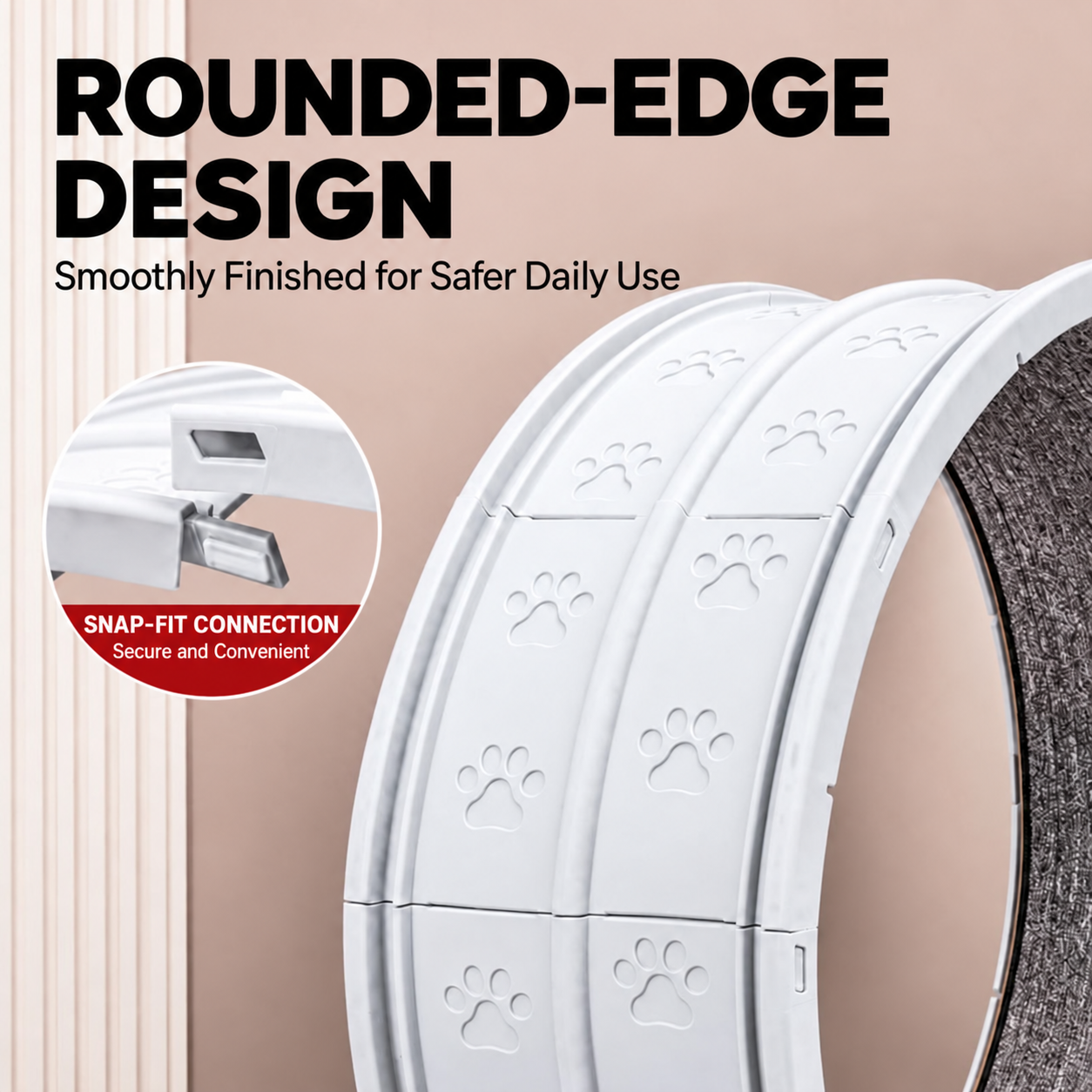
A large wheel can therefore ship as smaller modular sections. The logistics advantage comes from the modular design, but PP makes those parts easier to reproduce consistently.
Easier to Clean
PP has low water absorption and strong resistance to many aqueous solutions and common chemicals. Polypropylene is widely valued for chemical resistance.
That makes it practical for a product exposed to fur, dust, paw dirt, spilled water, and occasional urine.
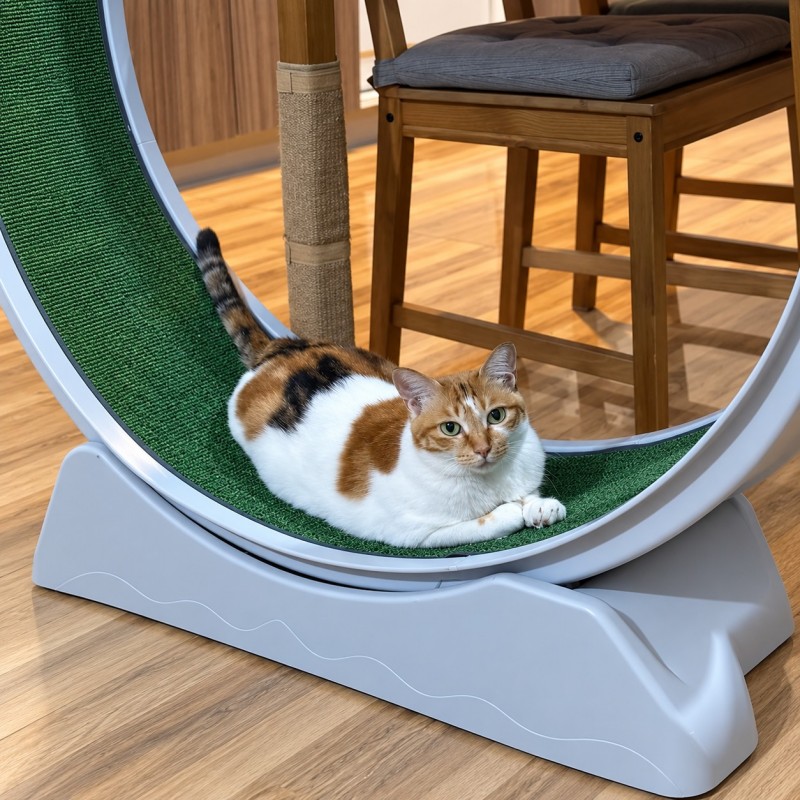
The PP ring can be wiped clean, while the running tread can be removed, cleaned, or replaced separately.
More Claw-Tolerant Than Fibre-Based Structures
A molded PP part has no wood fibre, veneer, or exposed board edge to splinter.
That does not mean PP is scratch-proof.
Polypropylene can scratch, and scratch visibility depends on resin grade, additives, color, and surface texture. Research on scratch behaviour in polypropylene confirms that surface deformation is a real material-performance issue.
The accurate seller message is:
PP is splinter-free and claw-tolerant, not indestructible.
Rounded Molded Geometry
Injection molding allows rounded corners and smooth transitions to be built into each part.
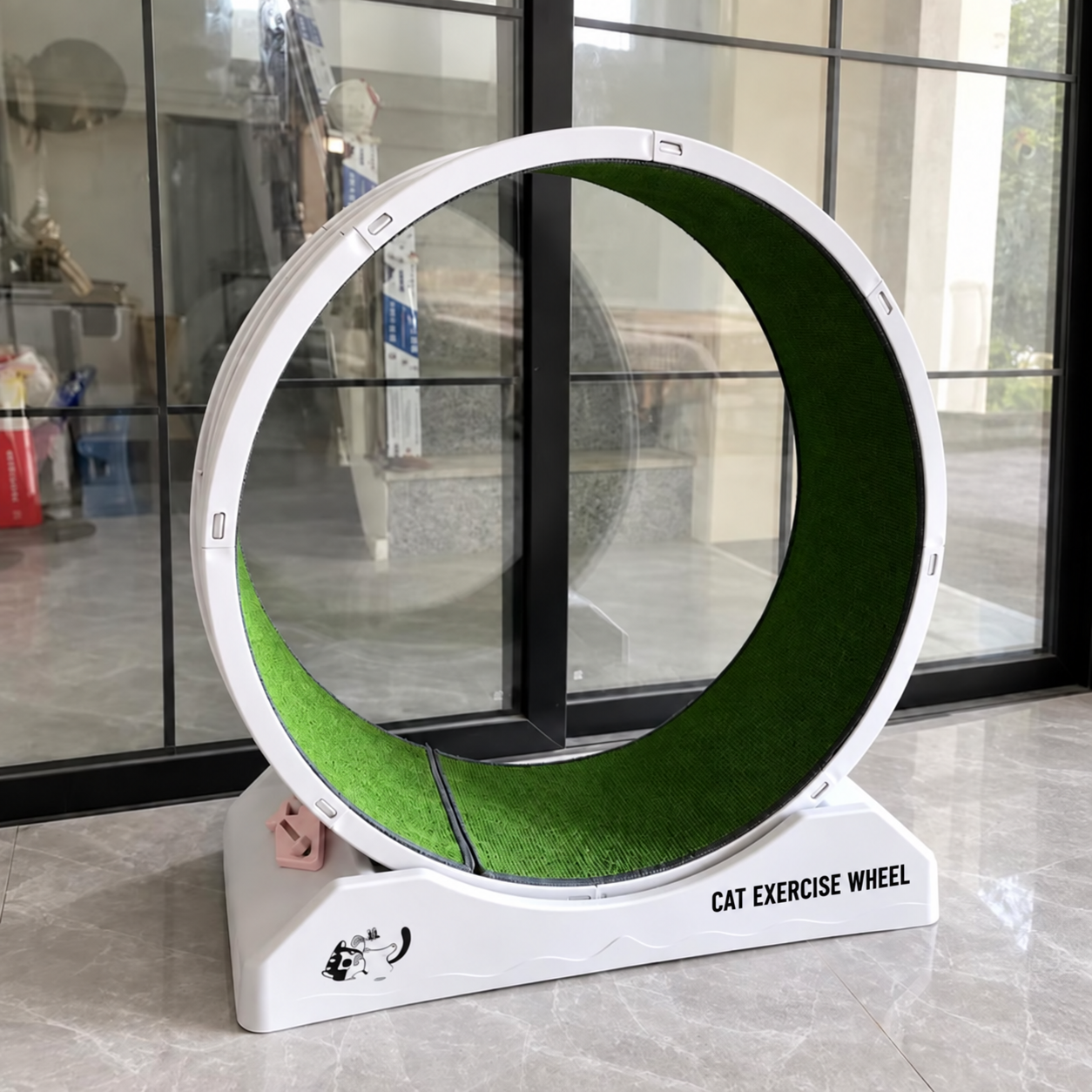
That is useful around outer ring edges, panel joints, hand-contact areas, and base covers.
Rounded parts do not automatically make the wheel safe. Moving-part gaps, roller guards, side clearances, and base stability still need correct engineering.
Easier Replacement-Part Programs
A modular PP wheel can support replacement ring sections, running mats, rollers, locks, and base parts.
For online sellers, this matters because cat wheels are bulky. Replacing one component can be much cheaper than replacing the entire wheel.
Better Private-Label Flexibility
Color can be molded into the resin instead of relying only on paint or lamination.
That supports white/grey, blue/white, neutral palettes, and coordinated spare parts.
For private-label programs, the structural wheel can stay standardized while color, tread, logo, instructions, and packaging change by market.
PP Plastic vs Wood Cat Wheels
Wood still has a place where furniture appearance is the priority.
| Decision Point | PP Plastic Wheel | Wood/Board Wheel |
|---|---|---|
| Product weight | Generally lighter | Generally heavier |
| Modular snap-fit design | Strong advantage | Less natural fit |
| Cleaning | Smooth shell wipes easily | Depends on finish |
| Moisture absorption | Very low in PP | Depends on coating |
| Splinter risk | No wood fibres | Possible if damaged |
| Rounded molded forms | Easy to repeat | Requires machining |
| Replacement sections | Easier to standardize | Usually less modular |
| Shipping design | Strong knock-down potential | Often heavier parts |
| Furniture appearance | Modern/technical | Stronger furniture feel |
The trend is not “plastic replaces wood.”
The trend is plastic creates a different commercial model: modular, lighter, cleaner, more replaceable, and better suited to e-commerce logistics.
Why Sellers Should Treat PP Wheels as a Category Opportunity
A cat wheel is not only an exercise product. It is also a large-format logistics product.
Margin is affected by carton size, product weight, assembly complaints, transit damage, returns, cleaning expectations, and spare-part support.
A well-designed PP wheel can improve several of those economics.
For a seller entering the category in 2026, I would not build the range around one heavy furniture-style wheel only.
I would consider at least one modular PP plastic wheel as the scalable online-retail direction.
Material Does Not Replace Good Wheel Geometry
PP does not fix poor sizing.
The cat runs on the inner curve, so inner diameter should always be published separately from outer diameter.
Our 2026 scan shows compact products around 29–35 inches inner diameter, mainstream large products in the low-40-inch range, larger premium directions around 48 inches, and extra-large products approaching 60 inches.
There is no published veterinary standard establishing one universal minimum diameter.
Track width, roller quality, wheel alignment, and base footprint still matter.
The Running Surface Still Decides Real Use
A light PP ring still needs a good tread.
Current wheels commonly use felt-like textile, carpet, EVA foam, or sectional traction pads.
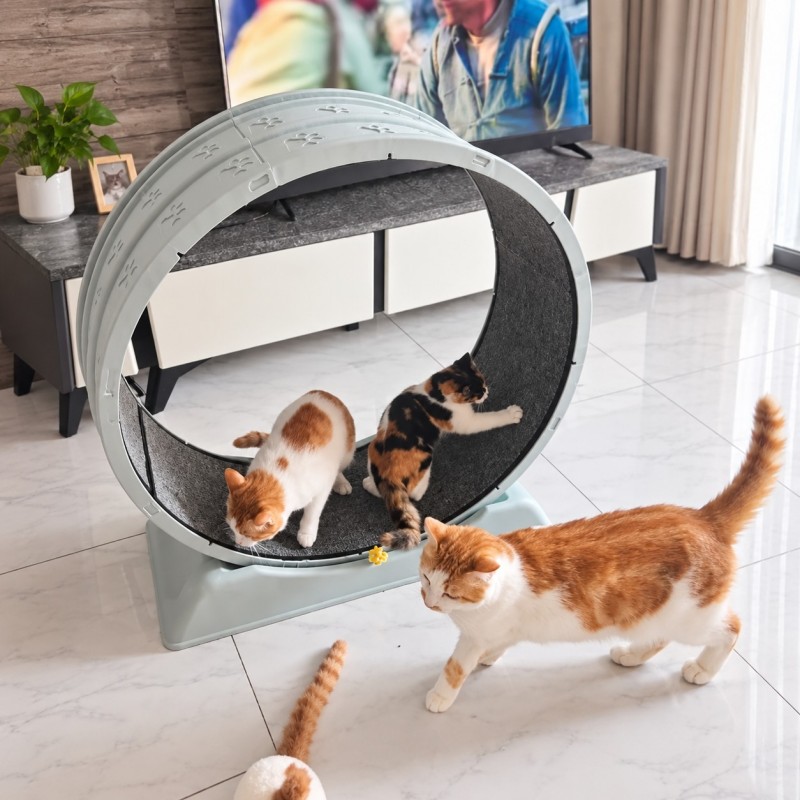
The tread should be checked for grip, lifted edges, claw-catching loops, hair accumulation, cleaning method, and replacement availability.
At Archova, our current PP direction uses removable sectional textile mats. Individual sections can be cleaned, inspected, or replaced instead of treating the whole track as permanent carpet.
Lightweight Does Not Mean the Base Can Be Weak
A lower-mass ring is easier to move, but fast running creates dynamic load.
I would still test base width, anti-slip contact, roller position, lateral movement, wheel tracking, jump-off movement, and panel alignment.
A plastic wheel becomes a better product only when lightweight ring design and stable base design are balanced.
Noise Depends on the Whole System
Plastic itself does not make a wheel silent.
Noise can come from rollers, bearings, panel joints, wheel alignment, floor resonance, and running speed.
Current market listings increasingly promote low-noise plastic wheels, which is another sign that this format is becoming commercially important.
But sellers should avoid “silent” unless the exact SKU has measured evidence.
How Archova Approaches PP Plastic Cat Exercise Wheels
At Archova, we see PP plastic as one of the strongest directions for the next generation of cat wheels.
Our current product direction uses:
- modular PP resin ring sections
- snap-fit curved-panel connections
- removable sectional running mats
- compact and wider floor-base options
- smooth molded exterior geometry
- knock-down packaging
- replaceable wear components
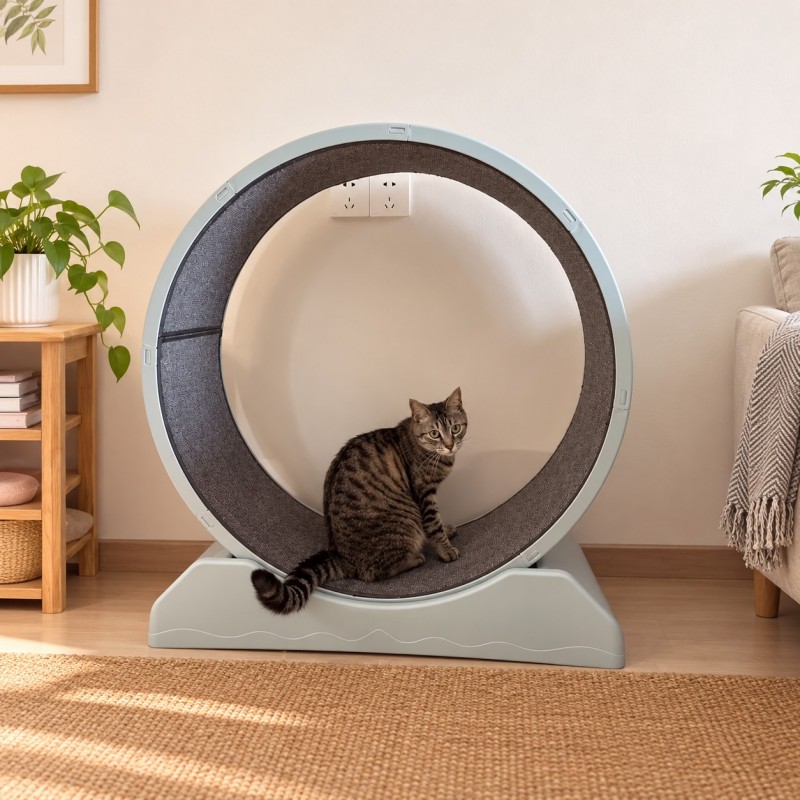
For private-label development, we can review body color, tread material, tread color, logo placement, replacement mats, instructions, carton artwork, and spare-part planning around a confirmed wheel-and-base model.
Wheel diameter, inner diameter, track width, product weight, running mechanism, brake or lock, and noise performance should still be confirmed by SKU.
That is the right way to sell the trend:
not “plastic is automatically better,” but “PP makes a lighter, cleaner, more modular and more scalable wheel architecture possible.”
FAQ
Are plastic cat exercise wheels better than wooden wheels?
They can be better for lightweight handling, modular assembly, wipe-clean maintenance, rounded molded parts, and replacement-component programs. Wood still suits furniture-style positioning.
Is PP plastic scratch-proof?
No. PP can scratch. The advantage is that it does not splinter like wood, and scratch visibility can be improved through resin grade, texture, color, and design.
Why are PP wheels easier to assemble?
PP can be injection-molded into repeatable curved sections with snap fits, ribs, locating features, and standardized connections.
Are PP cat wheels easier to move?
Usually, yes, because PP has low density. Final weight still depends on the base, hardware, and overall design.
Are plastic cat wheels easier to clean?
The molded shell is typically easier to wipe because PP has very low moisture absorption. The running mat should be removable or separately cleanable.
Does a lightweight plastic wheel wobble more?
It can if the base and roller system are weak. Lightweight ring design must be paired with a stable base and correct wheel tracking.
Is plastic really a trend in cat exercise wheels?
Yes. It is becoming a stronger product direction in 2026. Current specialty and mass-market listings increasingly use molded plastic, including PP and ABS, because of weight, assembly, cleaning, and logistics advantages.
What should sellers specify for a PP cat wheel?
Confirm inner diameter, outer diameter, track width, PP grade, ring construction, panel connection, base footprint, roller system, tread material, replacement parts, lock function, carton size, and evidence behind noise claims.
Conclusion
The best cat exercise wheel in 2026 is not defined by one material.
But sellers should pay attention to PP plastic cat wheels as a growing product direction.
PP gives product developers a useful combination of low weight, injection-molding flexibility, low moisture absorption, chemical resistance, smooth molded geometry, modular assembly, replaceable sections, and e-commerce-friendly knock-down design.
For pet owners, that can mean a wheel that is easier to assemble, move, wipe clean, and maintain.
For retailers and importers, it can mean a category that is easier to ship, customize, service, and scale.
A well-designed modular PP wheel is the opportunity.
References
- Detweiler et al. — Physical Activity Level of Female and Male Adult Cats Before and After Running Wheel Habituation
- FelineVMA — Meeting the Physical and Emotional Needs of Indoor Cats
- ScienceDirect — Polypropylene: Properties and Processing
- ScienceDirect — Polypropylene Chemical Resistance
- ASTM D5857-17(2024) — Polypropylene Injection and Extrusion Materials
- PMC — Correlation Between Scratch Behavior and Tensile Properties in Injection Molded and Extruded Polymers