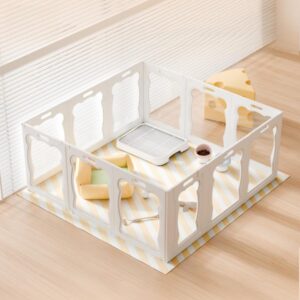
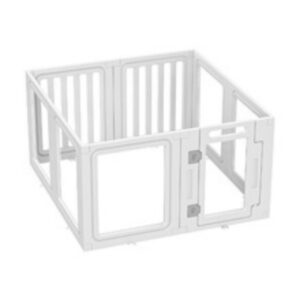
Project Snapshot
- Client: Amazon-focused pet brand entering the indoor dog containment category
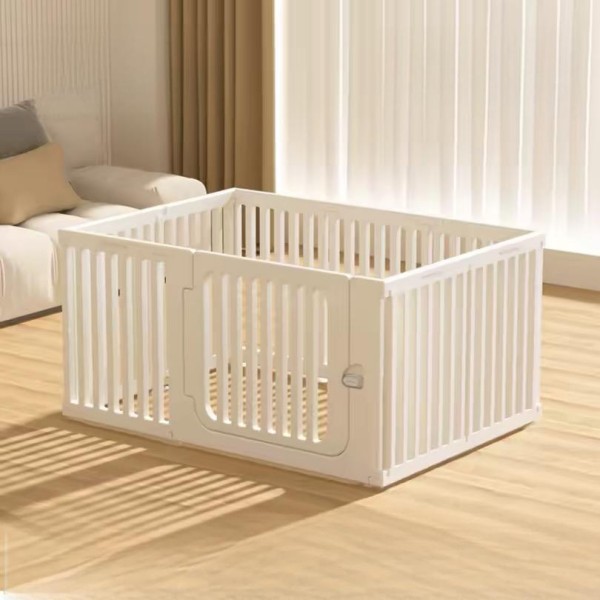
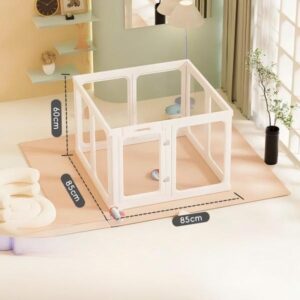
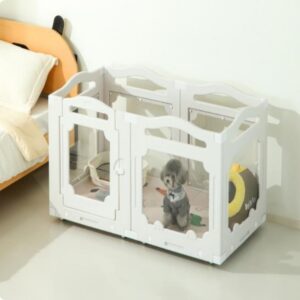
- Product: Modular plastic dog playpen
- Initial Direction: Proprietary molded appearance and custom structural details
- Core Commercial Risk: Opening tooling before the brand had ASIN-level evidence about the product attributes customers actually valued
- Archova Strategy: Mature platform → focused private label → Amazon market validation → targeted product revision → tooling decision
- What We Needed to Learn: Height, footprint, stability, gate usability, expandability, cleaning, packaging efficiency, price acceptance and return/review themes
The Real Amazon Problem Was Not “Can We Make a Different Playpen?”
The brand came to us with the same pressure many marketplace sellers face: a standard product can be launched quickly, but a listing that looks interchangeable with dozens of alternatives is difficult to defend. The instinct was to solve that problem with a new mold.
We did not reject custom development. We questioned the sequence. On Amazon, a visually different panel does not automatically solve the issues that determine ratings, returns, conversion or repeatability. Before locking a structure into tooling, the brand still needed to know which product problems were actually showing up in customer use.
We Researched the Category From the Review Backward
Public reviews across major pet retail channels repeatedly show a clear pattern in dog playpens. Positive feedback tends to reward easy assembly, modular expansion, a usable gate, floor protection, visual fit inside the home and enough stability for the intended dog. Negative feedback clusters around wobbling, sliding on smooth floors, weak or separating panel connections, pens that are too short for jumping puppies, gates that are missing or inconvenient, and products that feel too light for the dog size implied by the listing.
Those themes matter directly to an Amazon brand because the marketplace itself gives sellers tools to analyze customer reviews, return activity, pricing, demand and product-feature gaps. The first launch therefore needed to generate useful evidence, not simply revenue.
The Eight Questions We Wanted the First ASIN to Answer
- Height: Was the selected height appropriate for the intended puppy and small-dog segment, or were escape/jumping complaints appearing?
- Panel count and footprint: Did customers prefer compact apartment configurations, larger living-room enclosures or expandable sets?
- Floor stability: Did the pen stay where customers placed it on hardwood, laminate and tile, or did users need rugs, weights or improvised supports?
- Door and latch usability: Could owners enter, clean and manage the enclosure without awkward bending, lifting panels or bypassing the gate?
- Connections and rigidity: Did panels stay aligned when the pen was moved or pushed, or did joints loosen and change the enclosure shape?
- Cleaning and floor protection: Was the system practical around water spills, puppy accidents and frequent wipe-downs?
- Listing accuracy: Did the product dimensions, intended dog size and use cases match what customers believed they were buying?
- Fulfillment economics: Did the selected panel size, count and carton design create a sustainable FBA size/weight profile for the brand’s target price?
Why FBA Packaging Was Part of the Product Decision
For an Amazon seller, packaging is not a secondary detail. FBA fulfillment fees depend on product weight and dimensions, and storage charges depend on the cubic volume inventory occupies. A playpen can therefore become commercially weaker even when the product itself is acceptable if the panel geometry, panel count or carton configuration pushes the SKU into a less favorable fulfillment profile.
We treated carton dimensions, component nesting, hardware protection and missing-part prevention as product-development inputs. The brand needed a configuration that was compelling enough for the customer without carrying avoidable logistics cost or creating damage and component-loss risks in transit.
Stage 1 — Launch a Focused Private-Label Test, Not a Generic SKU Dump
We recommended using the mature Archova platform closest to the intended customer segment and limiting the first range to a disciplined set of options. The goal was to make the listing easy to understand and the data easy to interpret.
Depending on the approved model and order requirements, the first-stage program could include brand marks, color direction, instructions, labels, barcode information, packaging artwork and channel-specific carton requirements while retaining the proven molded architecture.
We deliberately avoided launching too many heights, colors and panel-count variations at once. Too many early variations divide reviews, inventory and advertising spend across multiple ASINs and make it harder to see which configuration is genuinely working.
Stage 2 — Turn Reviews and Returns Into an Engineering Brief
After launch, the question changes from “What can we customize?” to “What problem is repeatedly important enough to engineer?” Amazon provides sellers with review and return data precisely because these signals can reveal product gaps. For a playpen, we would look for repeated themes rather than isolated comments.
- If customers consistently report sliding, review floor-contact design, anti-slip interfaces or support geometry.
- If the gate receives repeated complaints, review opening width, threshold, latch position and one-handed operation.
- If customers outgrow the initial set, consider a clearer expansion-panel strategy or proprietary accessory interface.
- If escape complaints concentrate around one height, review whether the assortment needs a taller structural option rather than simply more colors.
- If connections loosen when the pen is moved, review joint geometry and locking behavior.
- If returns reflect “not as described,” correct the listing, sizing guidance and use-case positioning before assuming the mold is the problem.
- If damage or missing-part complaints appear, review packaging protection, hardware organization and QC rather than redesigning the core structure unnecessarily.
What We Would Customize First — and What We Would Not
- Brand presentation: Early-stage private label is appropriate because it creates ownership without locking structural assumptions into tooling.
- Color direction: Can often be validated before structural tooling.
- Panel-count bundles: Should be tested through SKU architecture before changing molded geometry.
- Instructions and setup guidance: Should be improved immediately when customer confusion appears.
- Gate/latch structure: Custom engineering only when repeated usability evidence supports a different mechanism.
- Panel height or geometry: Tooling only when demand is strong enough to support a proprietary structural size.
- Connection system: Tooling only when the mature platform cannot meet the validated rigidity or reconfiguration requirement.
- Accessory interface: Worth proprietary development when it creates a defensible ecosystem rather than a one-off cosmetic difference.
The Commercial Outcome
The brand could enter the Amazon dog-playpen category without making a proprietary mold the price of entry. More importantly, the first launch was structured to generate information the next product decision could use.
The mature platform gave the brand a way to test the market while preserving the option to move into a genuinely differentiated ODM program later. Any future tooling brief could be based on a repeated customer problem, a proven configuration preference or a clear logistics opportunity instead of an assumption made before the first ASIN went live.
Why This Matters for Amazon Pet Brands
Amazon rewards clarity and punishes ambiguity quickly. Customers compare dimensions, configurations, reviews and price side by side. Returns and negative review themes can expose a mismatch between the product promise and actual use within weeks.
Our role is to help a brand use that speed as an advantage. A mature product can shorten the path to real market evidence; private label can establish the brand layer; and custom tooling can be reserved for the point where the brand knows exactly what it is trying to improve.
For this type of project, the best first question is not “How quickly can we open a mold?” It is “Which customer problem will the mold solve that the current product cannot?”