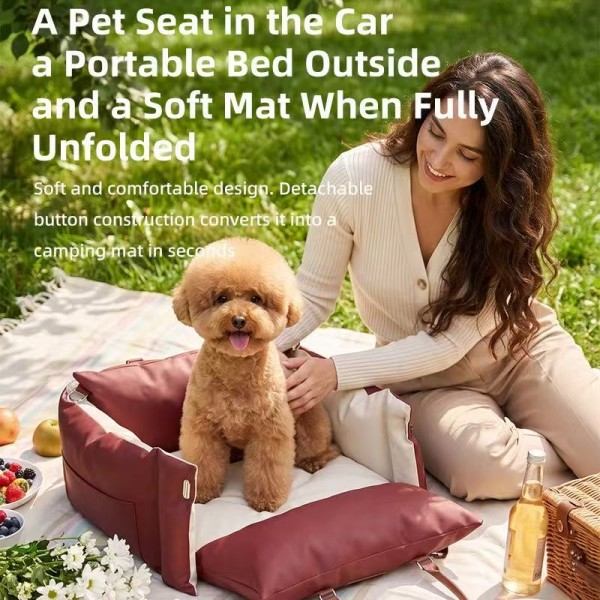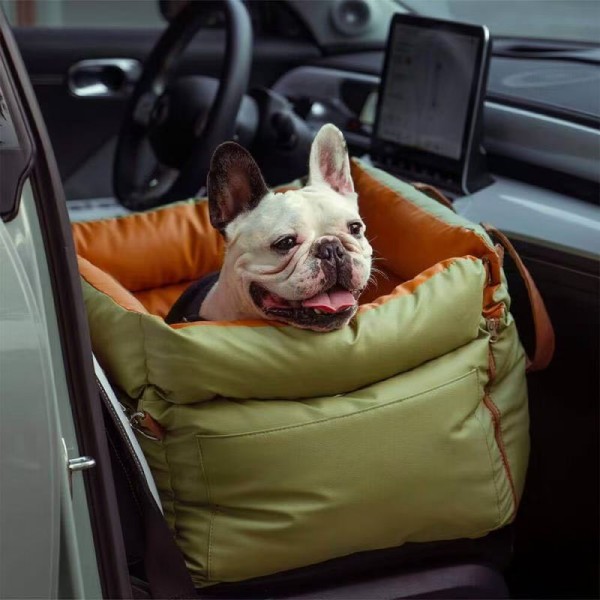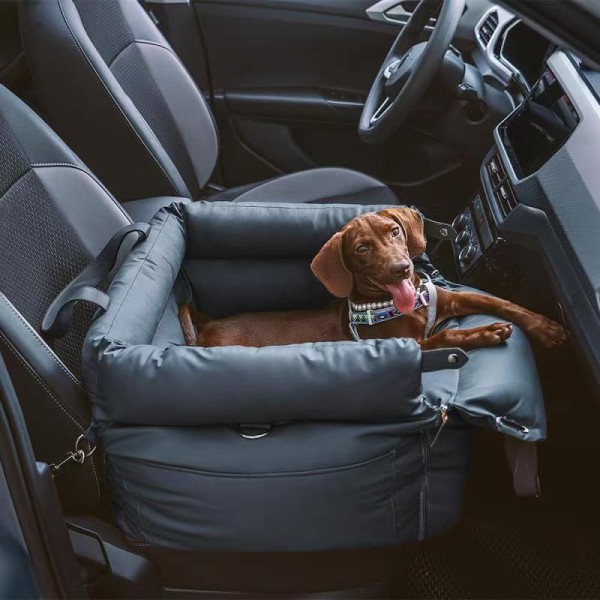
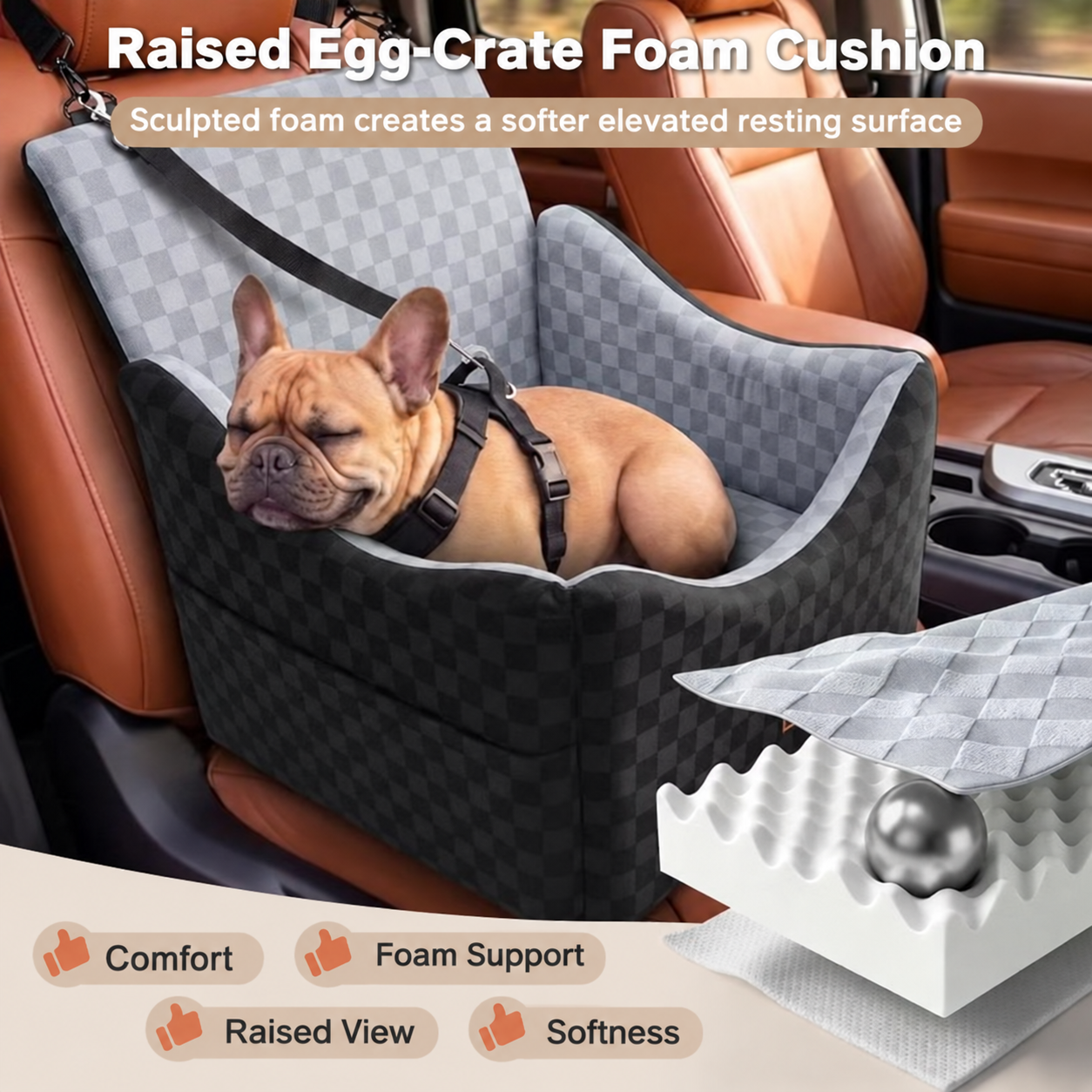
A console dog car seat is a narrow seat designed for a vehicle’s center console between the front seats. It mainly suits very small dogs and compatible consoles.
The format can improve proximity, viewing height, and cabin space use. However, it has stricter fit and safety limits than a rear-seat dog car seat.
At Archova, we would never treat “fits on the console” as enough. Dog fit, console fit, driver clearance, restraint, and airbag guidance must all work together.
What Makes a Console Dog Car Seat Different?
A regular booster sits on a vehicle seat. A console dog car seat normally sits on the raised armrest or storage console.
That changes the entire installation logic. The product relies on a narrow support surface instead of a full vehicle-seat cushion.
Console seats are therefore not simply smaller versions of a dog car booster seat. They need their own dimensions, strap layout, base support, and vehicle-fit instructions.
They also place the dog in the front cabin. That creates additional questions about driver distraction and vehicle airbag systems.
Independent pet travel seat research specifically includes console booster seats within the pet-seat category. It also separates these seats from full-containment crash restraints.
Quick Decision: Is a Console Seat the Right Format?
| Situation | Console Dog Car Seat | Better Alternative |
|---|---|---|
| Very small dog needs a compact resting area | Potentially suitable | Rear booster also works |
| Dog is too long to turn inside the console seat | Poor fit | Larger rear-seat car seat |
| Console top is narrow or highly curved | Poor fit | Rear-seat format |
| Console lid is split or cannot close around straps | Often difficult | Rear-seat format |
| Driver still needs full armrest and console access | Usually inconvenient | Rear-seat format |
| Dog repeatedly climbs toward the driver | Poor choice | Rear restraint or carrier |
| Vehicle manual creates airbag concerns | Avoid front-cabin placement | Rear-seat restraint |
| Rear seat must remain available for passengers | Space advantage | Console may help if fully compatible |
| Dog mainly wants a higher view | Useful feature | Rear booster offers elevation with more base area |
| Crash protection is the main goal | Not enough by itself | Verified harness, carrier, or crate |
A console seat works best when its narrow footprint solves a real space problem. Proximity alone should not override safer vehicle-placement options.
1. Measure the Console Before Measuring the Dog
Most fitting mistakes begin with the dog’s weight. For a console product, the vehicle should actually be measured first.
Measure the flat usable top surface, not the widest decorative edge. A molded edge or sloping armrest may not support the base.
Record the usable console length from front to rear. Then record the narrowest width under the seat’s intended base.
The seat should not depend on large unsupported overhangs. Overhang can increase rocking when the dog changes position.
Also measure the console height relative to both front seats. A tall console can place the dog much higher than expected.
Console Measurements That Actually Matter
| Measurement | What to Check | Why It Matters |
|---|---|---|
| Flat top length | Front-to-rear supported surface | Prevents rear or front overhang |
| Flat top width | Narrowest usable section | Determines base stability |
| Console height | Top surface relative to seat cushions | Changes final dog height |
| Lid opening style | Front hinge, side hinge, split lid, sliding lid | Affects strap routing |
| Lid seam | Where straps must cross | Can prevent proper closing |
| Rear clearance | Space behind the lid | Affects rear strap angle |
| Front clearance | Distance to shifter and controls | Prevents interference |
| Side clearance | Space between front seats | Prevents rubbing or compression |
| Strap path | Unobstructed route around the console | Determines installation stability |
| Console movement | Sliding or adjustable armrest sections | May make the mount unsuitable |
This table is more useful than a “universal fit” claim. Console geometry varies too much between vehicles for that wording.
2. Console Lid Design Can Make or Break the Installation
A one-piece lid is usually easier to understand. Straps can often pass around the lid or console body without crossing multiple moving sections.
A split lid creates a different problem. A strap may block one side from closing or migrate into the hinge area.
Sliding armrests can create another conflict. The seat may appear stable until the driver adjusts the console.
Some vehicles also use console-mounted controls, wireless charging pads, or cup holders. These areas should remain accessible and unobstructed.
At Archova, we would not recommend improvising a new strap path around controls. The product needs a defined installation route for the target console type.
3. Strap Length Is a Specification, Not a Minor Detail
A console seat can have the correct base size and still fail installation. Short straps may not reach the intended anchor path.
Very long straps create a different problem. Excess webbing can be difficult to tension without leaving movement.
The useful specification is not simply “adjustable straps.” It is the working adjustment range and intended routing path.
The buckle position also matters. A buckle sitting under the base can create a pressure point and prevent the seat from lying flat.
For OEM/ODM development, we would check strap length on target console fixtures. We would not set one length from product appearance alone.
4. Measure the Dog by Resting Footprint, Not Breed Name
Console seats are narrow by design. That makes usable inner space more important than the product’s outside dimensions.
Measure the dog while sitting naturally. Then measure the body footprint while curled or lying down.
A dog can fall within a weight label but still be too long. Long-backed small dogs are a common example.
The dog should be able to sit without the shoulders pressing hard into both sides. It should also be able to settle without hanging over the front.
For comparison, Archova’s rear-seat booster publishes both outside dimensions and a 15 × 15-inch usable cushion area. We use that same measurement principle for every compact travel format.
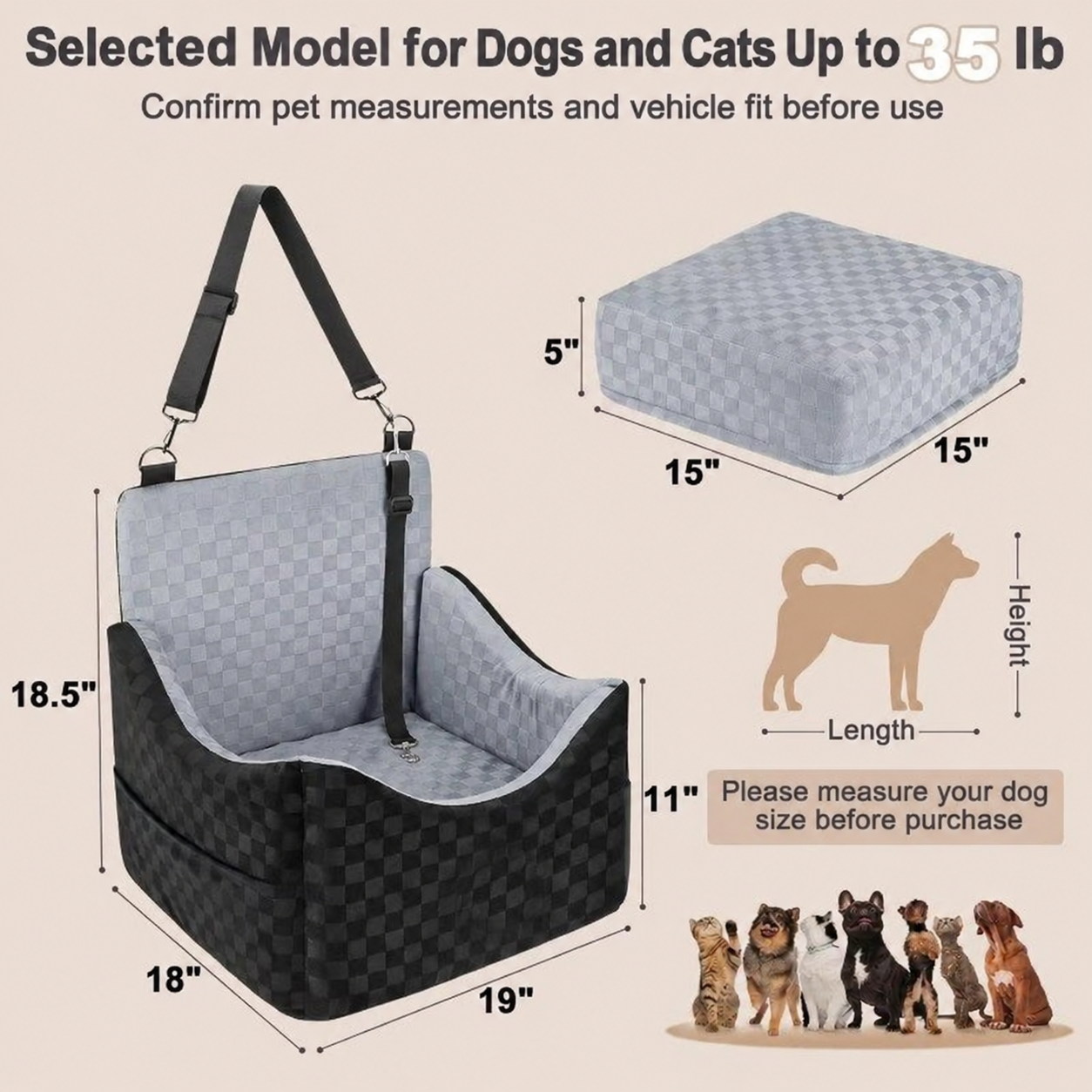
5. Weight Limits Do Not Tell You Whether the Seat Will Feel Stable
A weight label answers only one part of fit. It does not describe body length, dog movement, or console support.
A five-pound dog that constantly turns can move the seat differently from a calmer eight-pound dog. Base support and strap geometry still matter.
Do not turn a pet-fit weight into a crash-load rating. Those are completely different claims.
A console lid also has its own structural design. Do not assume it carries unlimited concentrated weight because an arm can rest on it.
Vehicle documentation should control any load or use restriction. When that information is unclear, use a rear-seat format instead.
6. The Dog Should Not Interfere With Driving
Proximity is the main reason many pet owners consider a console seat. It is also the format’s biggest behavioral risk.
The dog should not reach the steering wheel, gear selector, parking controls, or the driver’s hands. It should not climb into the driver’s lap.
Current distracted-driving guidance defines distraction broadly as anything taking attention from safe driving. An unsettled dog can create that same practical problem.
Older NHTSA driver-education material also identifies uncontained pets among in-vehicle distractions. The product must reduce interference rather than bring it closer.
A dog that repeatedly climbs toward the driver is not a good console-seat candidate. Use a more separated rear-seat restraint or carrier.
7. Front-Cabin Airbags Are the Safety Issue You Cannot Ignore
A console seat places the dog between the front seats. That location is much closer to front-cabin restraint systems than a rear-seat product.
Modern vehicles can use frontal and side airbags. Their exact locations and deployment strategies vary by model.
NHTSA airbag guidance emphasizes the injury risk from being too close to a deploying airbag. Airbags inflate extremely quickly.
Do not assume that a “PASSENGER AIR BAG OFF” light solves every issue. Occupant sensing and airbag layouts are vehicle-specific.
The owner’s manual must determine whether the console position conflicts with an airbag area. If the answer is unclear, rear-seat placement is the safer default.
This is also why Archova’s current published travel seats recommend rear-seat use. We do not reposition them onto a console and call that equivalent.
8. A Console Seat Is Not a Crash Restraint
A padded console seat can define where the dog rests. Its straps can help position the seat during normal driving.
Those functions do not prove crash protection. An internal tether also does not create a verified restraint system.
The Center for Pet Safety pet-seat study found serious performance differences among travel-seat designs. Failure modes included rotation and anchor-strap failure.
Current CPS certification information separates independently certified harnesses, carriers, and crates from ordinary comfort seats. That distinction should remain clear in product copy.
Use a verified restraint according to its own instructions. Do not attach a vehicle restraint to a dog collar.
9. The Tether Must Not Let the Dog Jump Over the Edge
A tether that is too long can create a dangerous configuration. The dog may jump out while remaining attached.
A console seat makes this particularly important because the resting surface is elevated. The dog can become suspended beside the seat.
The tether should connect only as the approved instructions specify. It should never be shortened with improvised knots or random hardware.
A longer connection is not automatically more comfortable or safer. Extra movement can increase excursion during sudden deceleration.
For Archova product development, tether length would be reviewed with the seat geometry. It cannot be treated as a universal accessory dimension.
10. Firm Sidewalls Matter More on a Narrow Console
Soft padding is valuable for comfort. A console seat still needs enough shape to keep the usable area stable.
Walls that collapse outward reduce the interior boundary. They can also make the dog feel less supported during turns.
Very rigid edges create the opposite problem. They can become uncomfortable when the dog leans against them.
The useful target is controlled shape retention with padded contact surfaces. That balance should be checked after packing and repeated use.
Foam recovery also matters after compressed shipping. A console seat that never regains its shape will not match its published fit dimensions.
11. The Base Should Sit Flat Before the Dog Goes Inside
A non-slip base can improve surface grip. It cannot correct poor console geometry.
Place the empty seat on the console first. Confirm the base remains flat after every strap is tensioned.
Then apply light hand pressure from different directions. Significant rocking indicates a fit problem before the dog enters.
Check the seat again after moving the driver and passenger seats. Front-seat adjustment can change strap angles on some designs.
Do not solve instability by placing loose towels or cushions underneath. Added layers can move and change the installed geometry.
12. Comfort Means More Than Plush Fabric
Console seats are small, so every material choice affects usable space. Thick plush can make a narrow interior even narrower.
A comfortable base should provide enough padding without creating unstable sink. Sidewalls should support resting without squeezing the body.
Breathability also matters in the front cabin. However, mesh should be described as passive airflow material, not active cooling.
For dogs that mainly sleep during travel, a larger small dog car seat can be the better choice. More horizontal space may matter more than driver proximity.

13. Cleaning Should Be Planned Around the Console
Console products sit near cup holders, storage lids, and frequently touched surfaces. Dirt and hair can therefore spread through the front cabin quickly.
A removable cover or cushion simplifies routine care. The exact washable parts should be stated clearly.
Water-resistant fabric is not the same as waterproof construction. Seams, zippers, and openings can still allow liquid through.
The base material also deserves attention. Dark anti-slip coatings should be checked for transfer on light leather or vinyl.
For private-label specifications, we would define surface cleaning, removable parts, drying method, and upholstery-contact material separately.
14. Console Seat vs Rear-Seat Booster
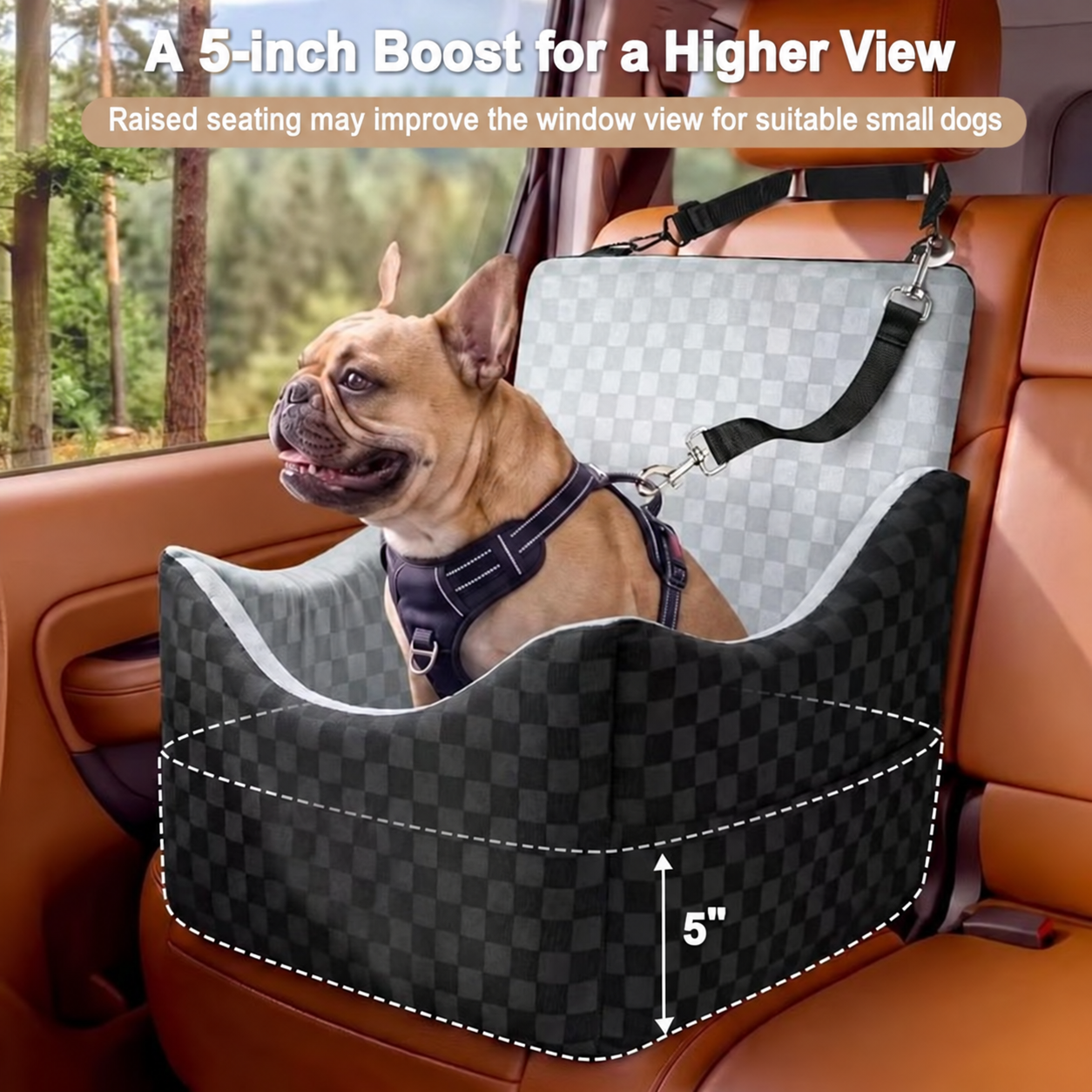
A console seat wins on proximity and narrow cabin footprint. A rear booster wins on supported base area and separation from the driver.
Archova’s rear dog car booster seat uses a full vehicle-seat position. Its headrest straps, belt-routing loops, and non-slip base follow that geometry.
A console seat needs a completely different anchoring concept. We would not convert the rear booster by simply adding longer straps.
| Decision Point | Console Dog Car Seat | Rear-Seat Booster |
|---|---|---|
| Main placement | Center console | Vehicle seat |
| Typical dog size | Very small dogs | Small dogs by model |
| Base support | Narrow console top | Full seat cushion |
| Driver proximity | Very high | Lower |
| Driver interference risk | Higher | Lower |
| Console access | Usually reduced | Unaffected |
| Airbag evaluation | Critical front-cabin issue | Rear placement simplifies the decision |
| Window elevation | Often high | Model-dependent |
| Installation variability | Very high | Still vehicle-dependent |
| Best use | Narrow, compatible console and calm tiny dog | General small-dog rear-seat travel |
15. Console Seat vs Regular Rear-Seat Car Seat
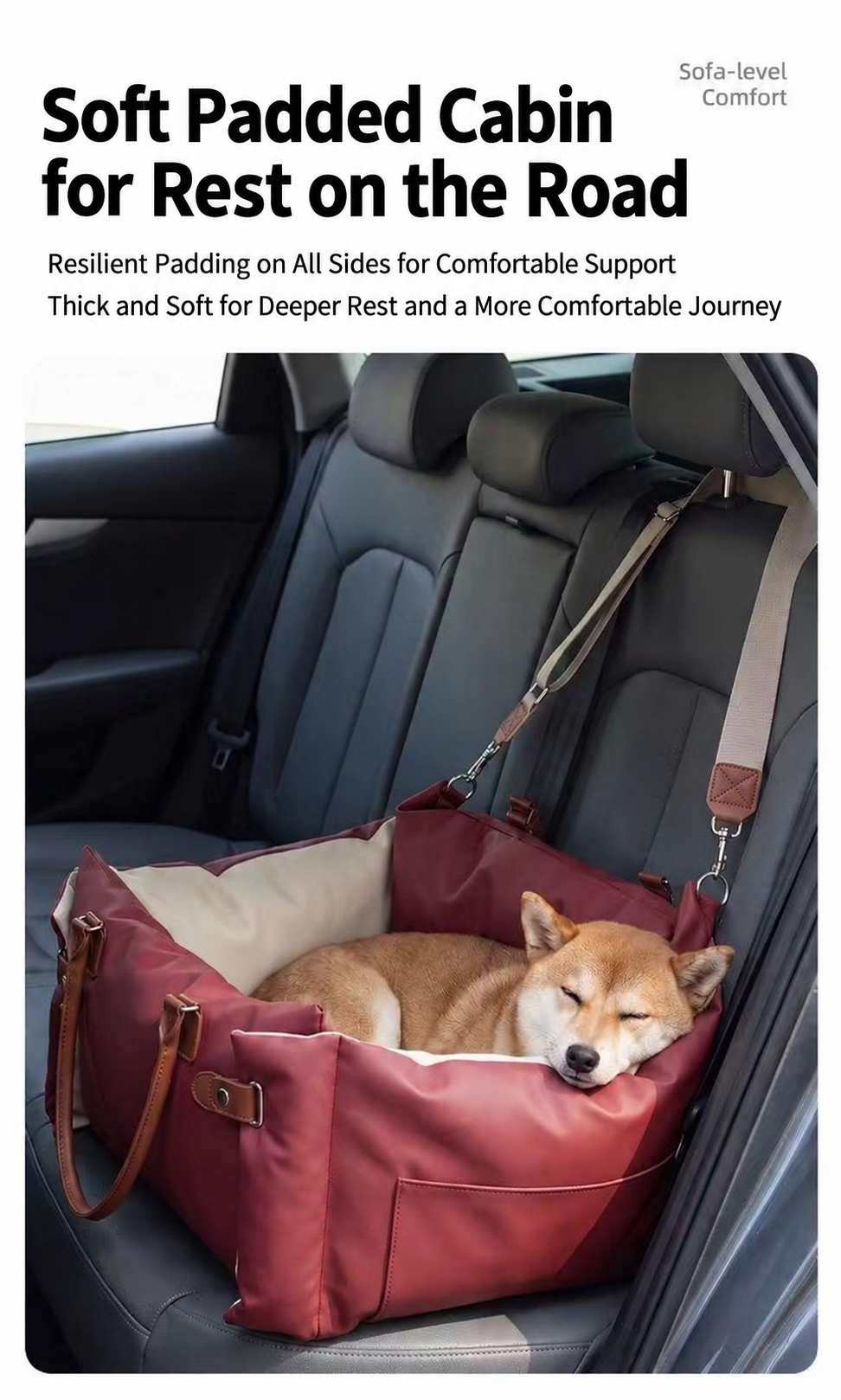
A regular rear-seat car seat gives product designers more width and depth. That makes it easier to support curling and lying postures.
Archova’s pet car seat for dogs range includes compact and wider rear-seat directions. Those formats focus on resting area and upholstery management.
A console seat should therefore solve a narrower need. It should not replace the rear-seat category for every small dog.
16. When a Console Dog Car Seat Is the Wrong Choice
Choose another format when the console is too narrow or strongly curved. The same applies when the seat needs large unsupported overhangs.
Avoid the format when straps interfere with lid closure. Do not use it when driver-seat movement loosens the installation.
Use another solution when the dog cannot turn or settle inside. Weight alone should not justify a cramped fit.
A console seat is also unsuitable for persistent climbers. Proximity has little value if the dog keeps entering the driver’s working space.
Finally, avoid front-cabin placement when the vehicle manual raises airbag concerns. Rear-seat restraint remains the clearer default.
17. How to Install a Console Seat More Carefully
Start with the parked vehicle on level ground. Remove loose objects from the console and surrounding controls.
Place the empty seat on the intended support area. Confirm the base fits before routing any strap.
Route every strap exactly as designed. Keep webbing away from hinges, buttons, sliding tracks, and moving seat hardware.
Tighten the straps gradually and evenly. Recheck whether the lid still closes and whether the base remains flat.
Move both front seats through their normal adjustment range. The console seat should remain stable without entering either occupant space.
Place the dog inside only after the empty installation passes those checks. Introduce the setup while the vehicle remains stationary.
Gradual acclimation is consistent with current veterinary travel guidance. Short practice sessions are more useful than forcing a distressed dog through a long trip.
18. A Better Product Specification for Console Seats
A serious console-seat listing needs more than overall dimensions and a weight limit. The vehicle side of the fit should be documented too.
| Specification Field | What Should Be Published |
|---|---|
| Outer seat dimensions | Width × depth × height |
| Usable inner dimensions | Actual dog resting area |
| Recommended dog fit | Weight direction plus body-fit guidance |
| Console support range | Minimum usable length and width |
| Console type | One-piece, split, sliding, or compatible styles |
| Strap adjustment range | Minimum and maximum usable length |
| Strap routing | Clear installation path |
| Base material | Upholstery-contact and anti-slip construction |
| Sidewall structure | Foam, board, or other support direction |
| Cushion construction | Thickness and removable parts |
| Cleaning | Exactly which components can be washed |
| Vehicle limitations | Controls, lid, seat movement, and airbag warnings |
| Internal tether | Purpose and permitted harness connection |
| Crash statement | Verified evidence or explicit limitation |
This level of specification reduces fit-related returns. It also gives retail teams an answer when a vehicle is incompatible.
19. What We Would Check for an Archova Console-Seat Project
Our current published car-seat range focuses on rear-seat formats. We would not relabel an existing rear-seat SKU as a console seat.
A console project would start with target vehicle geometry. Console width, lid type, strap route, and driver clearance would come before fabric selection.
Next, we would define the dog’s usable inner area. Outer dimensions would be built around that space and the supported console footprint.
Sidewall recovery, strap adjustment, buckle position, base grip, and washable components would then be reviewed together. None of these details should be isolated from installation.
Color, textile, trim, labels, and packaging can follow after the structure is stable. Restraint claims would remain separate from comfort and placement claims.
That approach gives a pet brand a real product specification. It is more defensible than starting with a generic “fits most cars” claim.
20. Final Buying Checklist
Before choosing a console dog car seat, confirm all of the following:
- The dog fits the usable inner area, not only the weight label.
- The console provides enough flat length and width for the base.
- The lid can close without crushing or loosening the straps.
- The console does not slide or move under the installed product.
- Driver and passenger seat adjustment does not change the fit.
- The product does not block shifters, cup holders, brakes, or controls.
- The dog cannot enter the driver’s lap or steering area.
- The vehicle manual does not create an unresolved airbag conflict.
- The internal tether connects only to the approved harness setup.
- Crash protection comes from a separately verified restraint.
- The base remains flat after the dog changes position.
- Washable parts and care instructions are clearly defined.
If several of these points cannot be confirmed, choose a rear-seat product instead. A console format should earn its place through compatibility, not convenience alone.
Final Verdict
A console dog car seat can work well for a calm, very small dog in a genuinely compatible vehicle. Its strongest benefits are proximity, elevation, and efficient cabin space.
Its biggest weaknesses are narrow fit, high installation variability, front-cabin distraction, and airbag complexity. Those limits make careful measurement essential.
For most dogs, a rear-seat harness, carrier, crate, or compatible comfort seat provides a simpler safety path. A console seat should remain a specialized format.
That is how Archova evaluates the category. Good fit begins with actual geometry, and safety claims never come from product shape alone.
Frequently Asked Questions
What is a console dog car seat?
It is a compact dog seat designed for the vehicle’s center console between the front seats. Most models target very small dogs.
The seat may add elevation and keep the dog close to the driver. It still needs its own vehicle-fit and restraint evaluation.
Are console dog car seats safe?
The format is not automatically crash safe. Console straps and internal tethers do not prove collision performance.
Use a verified restraint according to its instructions. Also check the vehicle manual for front-cabin airbag limitations.
What size dog fits a console car seat?
Use the seat’s usable inner length and width first. Then compare those measurements with the dog’s normal resting footprint.
Weight is only a secondary fit guide. Long-backed dogs can outgrow narrow console seats at relatively low weights.
How do I know whether a console seat fits my vehicle?
Measure the flat console top, lid type, strap path, and surrounding clearance. Do not measure only the widest exterior trim.
The installed seat should not rock or overhang heavily. It must also avoid controls and moving console sections.
Can a console seat fit a split center console?
Some designs may work, but split lids create extra strap and hinge conflicts. Compatibility must be verified for the exact product.
Do not force straps into a closing lid. Choose another format when the intended routing cannot remain secure.
Can I still open the center console?
That depends on the product and vehicle. Many console seats reduce or eliminate normal lid access while installed.
Frequent console access can also loosen some strap layouts. Treat storage access as part of the fit decision.
Is a console seat better than a rear booster?
It is better only when proximity and narrow footprint are genuinely useful. A rear booster usually has more supported base area.
Rear placement also reduces direct driver interference. The dog’s behavior and vehicle layout should decide.
Can the internal tether attach to a collar?
No vehicle restraint should rely on a standard collar connection. Use the approved harness and restraint instructions.
An included tether should not be described as crash tested without evidence. Its function may be limited to ordinary movement control.
Does a console dog seat help travel anxiety?
Being closer to the driver may help some dogs settle. It is not a treatment for anxiety or motion sickness.
Persistent distress deserves gradual travel training and veterinary guidance. Product proximity should not replace behavioral work.
What should a pet brand request from a console-seat supplier?
Request usable inner dimensions, console-fit limits, strap ranges, installation diagrams, cleaning instructions, and material specifications. Vehicle limitations should also be explicit.
Ask separately for any restraint or crash evidence. Do not allow “safety tether” wording to substitute for documented performance.
References
- Center for Pet Safety — Pet Seat Pilot Study
- Center for Pet Safety — Understanding CPS Certified Claims
- Cornell University College of Veterinary Medicine — Traveling Safely With Your Dog
- NHTSA — Vehicle Air Bags and Injury Prevention
- NHTSA — Distracted Driving
- VCA Animal Hospitals — Dog Behavior and Training: Air and Car Travel
- ASPCA — Traveling With Pets: Expert Dos and Don’ts