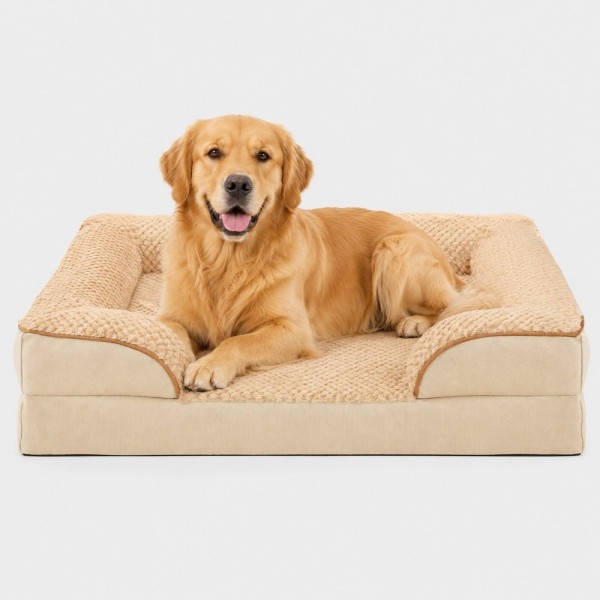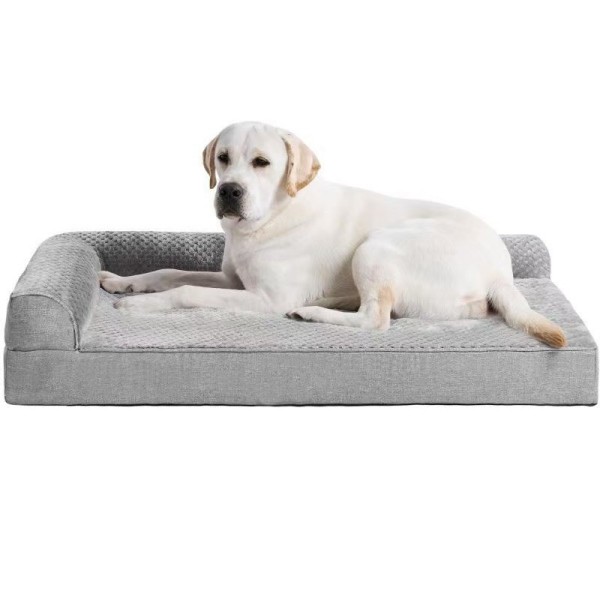
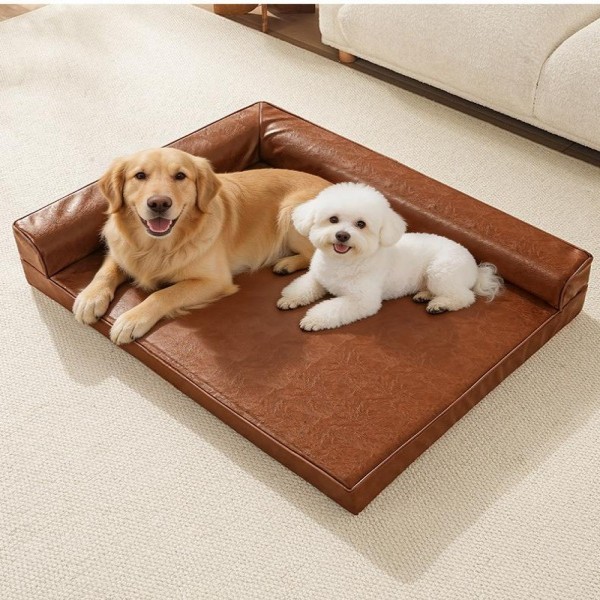
An orthopedic dog bed should be judged by what is inside it and how it performs under the dog—not by the word “orthopedic” on the product page.
The useful buying questions are practical: Does the support core resist bottoming out? Is the sleeping area large enough? Can the dog enter easily? Can the cover be removed? Is the foam protected? Will the structure still perform after months of use?
For retailers and importers, those same questions decide whether an orthopedic bed becomes a premium problem-solving SKU or simply a more expensive normal bed.
1. “Orthopedic” Should Describe the Support System
A stronger orthopedic bed has a deliberate support structure.
That may include memory foam, high-density foam, latex, layered foam, or another resilient material designed to keep cushioning underneath the dog.
An orthopedic dog bed should therefore be evaluated from the core outward.
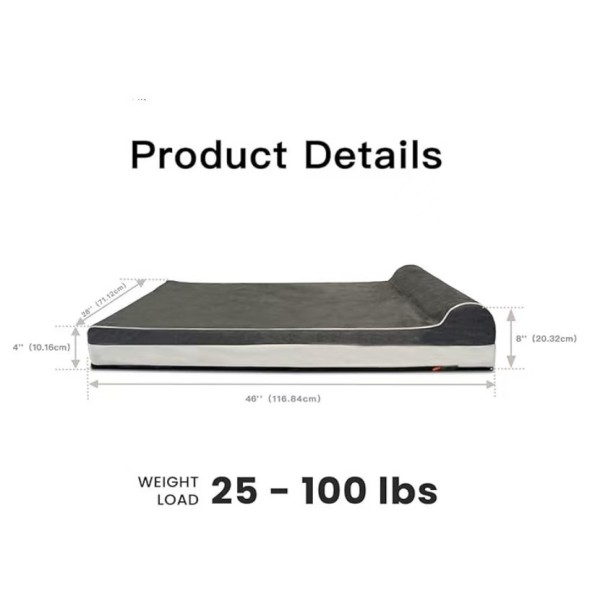
I would check:
- core material
- support depth
- firmness
- compression recovery
- usable sleeping area
For B2B buyers, the key risk is approving a supportive sample and receiving bulk production with thinner or lower-density material.
2. More Foam Does Not Automatically Mean Better Support
Thickness alone is not enough.
A thick, soft foam can collapse under a heavier dog. A thinner but denser layered construction may keep more effective support underneath the body.
A flat orthopedic dog mattress makes this easier to compare.
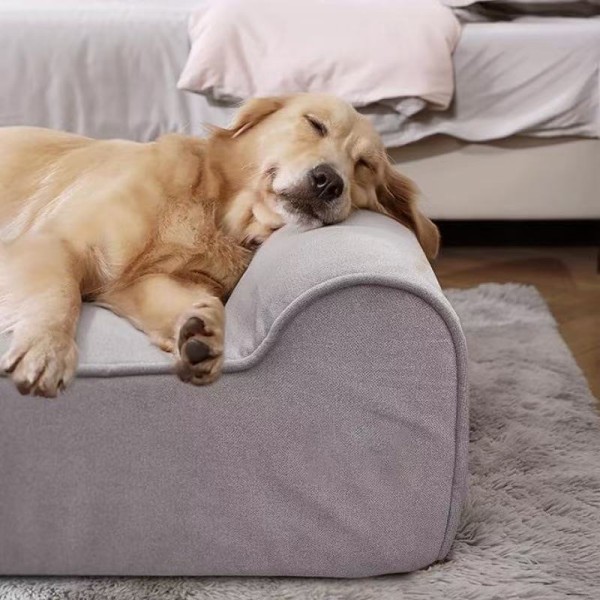
When reviewing a sample, I would ask:
- Does the dog sink through to the hard floor?
- Does the foam recover after use?
- Does the centre stay level?
- Does support change by size?
For large-dog ranges, those questions matter more than an impressive thickness number.
3. Dog Weight Changes What “Supportive” Means
The same bed can perform very differently under a small dog and a large dog.
A lightweight dog may be comfortable on a softer construction. A heavier dog needs enough resistance to keep the torso supported.
That is why a large orthopedic dog bed should not simply be a larger cover around the same internal structure.
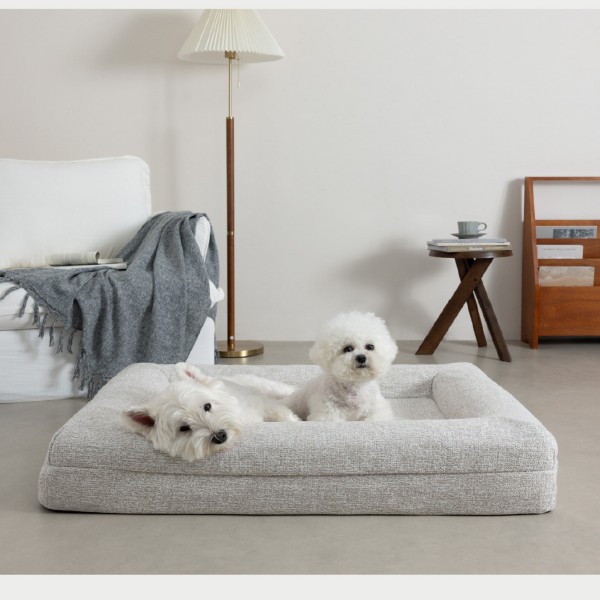
For larger sizes, I would review support depth, firmness, centre support, seam strength, and long-term compression.
A single foam specification across S, M, L, and XL may simplify production, but it does not always create the best product.
4. Senior-Dog Design Is More Than Memory Foam
Senior dogs are one of the strongest use cases for orthopedic bedding.
But the product should solve more than cushioning.
A useful senior bed combines support with easier access and stable floor contact. Environmental changes such as orthopedic bedding and nonslip surfaces can make daily movement easier for pets with reduced mobility.
I would prioritise:
- low front entry
- supportive core
- non-skid base
- turning space
- removable cover
- moisture protection
A deep sofa-style bed can look premium but still be inconvenient if the front wall is too high.
5. Orthopedic Beds Support Comfort; They Do Not Treat Disease
An orthopedic bed can provide cushioning, reduce direct contact with a hard floor, and create a more supportive resting environment.
It does not cure arthritis, hip dysplasia, injury, or chronic pain.
Dogs with osteoarthritis may show stiffness, pain, reduced activity, or difficulty using affected limbs. Those changes belong in veterinary care, not product marketing.
For product pages, better language includes:
- supportive foam
- cushioning from hard floors
- low-entry structure
- pressure-distributing support
- senior-friendly resting design
Objective claims should be supportable. The FTC’s advertising guidance is a useful benchmark for keeping product claims realistic.
6. Usable Sleeping Area Matters More Than Outer Dimensions
A bolster bed may measure 100 cm across but provide much less actual sleeping space once thick sides are deducted.
For pet owners, that creates a common disappointment: the listed size sounds correct, but the dog cannot stretch comfortably inside the centre area.
For retailers, size confusion creates avoidable returns.
I would show:
- outside dimensions
- usable centre dimensions
- front-entry width
- bolster height
The product should be sized around resting posture, not only breed labels.
7. Entry Height Can Decide Whether the Dog Uses the Bed
A premium bed that is difficult to enter can fail even when the foam is excellent.
This matters especially for senior dogs, short-legged dogs, and dogs with reduced mobility.
A furniture-style orthopedic dog sofa can provide useful head and side support, but the main access point should remain practical.
A mobility-focused setup benefits from easy access and stable nonslip surroundings.
For product-line planning, full-bolster and low-entry orthopedic beds should be treated as different functions.
8. Cleaning Structure Can Matter More Than the Fabric
Pet owners notice cleaning problems long after they stop noticing the original colour.
For orthopedic beds, the ideal structure separates washable components from the support core.
I would look for:
- removable outer cover
- accessible zipper
- protective inner liner
- support core that stays dry
For crate use, an orthopedic dog bed for crate should also be easy to remove and reinstall.
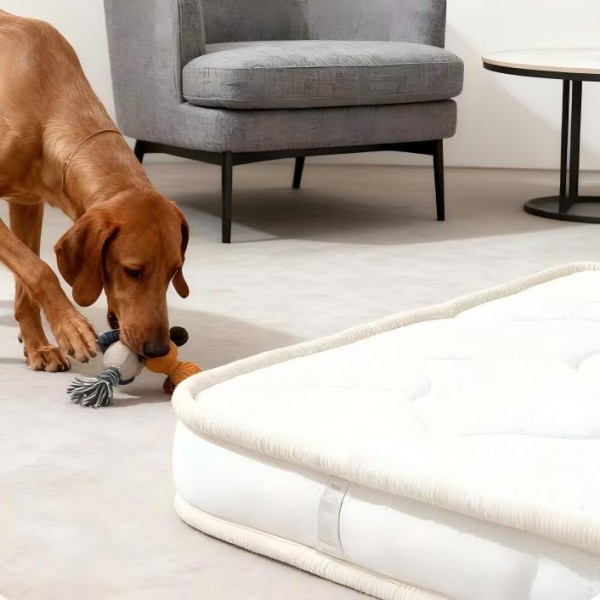
Routine pet-bed cleaning should follow the material and care instructions.
Do not assume the foam core can be machine washed.
9. Waterproof Protection Needs Precise Language
A moisture barrier around the foam can be valuable for senior dogs, puppies, or occasional accidents.
But “waterproof bed” and “waterproof liner” are not the same claim.
A liner may protect the foam while the outer cover absorbs moisture, zipper areas remain vulnerable, or seams are not fully sealed.
For B2B development, specify exactly which layer provides moisture protection.
That creates more accurate product pages and fewer unrealistic expectations.
10. Cooling and Orthopedic Support Are Separate Functions
A dog can need structured support and still prefer a cooler surface.
That is where a cooling orthopedic dog bed becomes a distinct product direction.
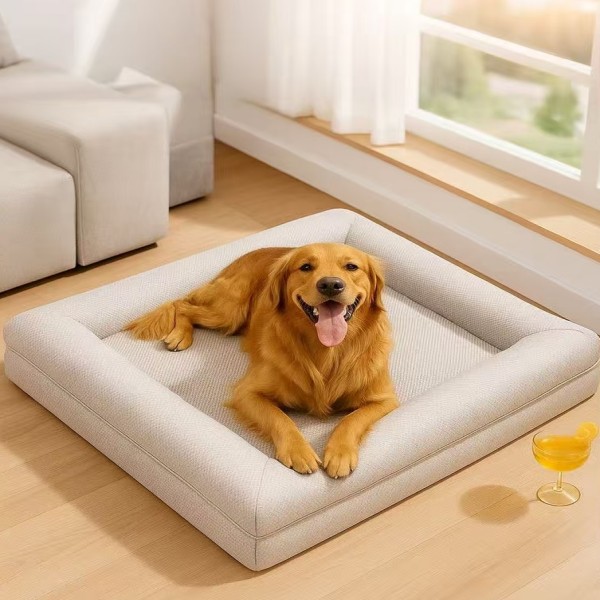
The two claims should stay separate.
Orthopedic describes the support system.
Cooling should describe the actual cooling mechanism, fabric, airflow design, gel layer, or other thermal feature.
A light-coloured fabric is not automatically a cooling system.
11. Durability Is Part of Orthopedic Performance
A bed is not meaningfully supportive if the core collapses after a short period.
I would test samples for:
- repeated compression
- centre sagging
- edge deformation
- cover stretching
- seam movement
- zipper stress
For B2B buyers, durability changes the real economics.
A slightly higher-cost construction can be commercially stronger if it reduces flattening complaints and premature replacement.
The best premium story is support that remains useful over time.
12. Not Every Dog Needs an Orthopedic Bed
A young, lightweight dog may be comfortable in a simpler padded bed. A puppy may need washable construction more than premium foam. A dog that likes nesting may prefer a softer bolster.
A strong retail range usually includes different jobs:
| Product Direction | Main Use | Retail Role |
|---|---|---|
| Basic padded bed | Young/small dogs | Entry price |
| Soft bolster bed | Nesting comfort | Mainstream |
| Orthopedic mattress | Large dogs | Functional upgrade |
| Low-entry orthopedic bed | Senior dogs | Support-focused |
| Orthopedic sofa | Visible home spaces | Premium |
| Cooling orthopedic bed | Warm weather | Seasonal function |
| Crate orthopedic pad | Crate use | Space-specific add-on |
This gives pet owners a reason to choose instead of simply pushing them toward the most expensive bed.
What I Would Ask a Supplier Before Ordering
Before buying orthopedic dog beds in bulk, I would ask:
- What is the support-core material?
- What is the thickness of each layer?
- Does construction change by size?
- What is the usable sleeping area?
- How high is the entry?
- Is the cover removable?
- Is there a protective liner?
- Which layer is waterproof or water-resistant?
- What prevents sliding?
- How is compression recovery checked?
- Will bulk production match the approved sample?
Those questions expose more real product differences than asking whether the bed is “premium orthopedic.”
How Archova Approaches Orthopedic Dog Beds
At Archova, we start with the support structure and use scene.
For senior-dog directions, we look at support, low entry, floor grip, cleaning, and moisture protection.
For large-dog directions, we focus on support depth, usable centre area, compression resistance, and seam strength.
For living-room products, orthopedic support can be combined with sofa-style bolsters and more furniture-oriented fabrics.
For warm-weather collections, cooling functions can be added without weakening the core support specification.
For private-label development, we can also adjust sizes, covers, liners, fabrics, colours, packaging, and assortment structure.
The goal is not to put “orthopedic” on more SKUs.
It is to make each orthopedic SKU solve a clear resting problem.
FAQ
Does an orthopedic dog bed have to use memory foam?
No. Memory foam is one possible support material. Latex, layered foam, high-density foam, and other resilient structures can also be used.
How thick should an orthopedic dog bed be?
There is no single correct thickness. Dog weight, foam firmness, layer construction, and bottoming-out resistance matter together.
Are orthopedic dog beds only for senior dogs?
No. Large, heavy, or support-focused adult dogs may also benefit from a more structured resting surface.
Can an orthopedic dog bed help arthritis?
It can provide a more supportive resting environment, but it does not treat arthritis. Mobility or pain changes should be discussed with a veterinarian.
Should orthopedic beds have a waterproof liner?
A protective liner can be useful, especially for senior dogs or occasional accidents. Check exactly which component is waterproof or water-resistant.
Are orthopedic dog beds hot?
Some foam structures can feel warmer than thin beds. Cover material, airflow, room temperature, and cooling features affect seasonal comfort.
What should retailers check before sourcing orthopedic beds?
Check support material, layer thickness, usable area, entry height, cover and liner structure, floor grip, compression recovery, packaging, and sample-to-bulk consistency.
Conclusion
What you need to know about orthopedic dog beds is simple: the label is only the beginning.
The real product is the support core, usable size, entry design, cleaning structure, moisture protection, seasonal comfort, and long-term recovery.
For pet owners, those details decide whether the bed actually fits the dog.
For retailers and importers, they decide whether the product earns a premium position—or creates expensive complaints later.
References
- AAHA — Supporting Your Senior Pet
- AAHA — How to Assess Your Senior Pet's Quality of Life
- Cornell University — Osteoarthritis
- AVMA — Caring for Senior Cats and Dogs
- RSPCA — Choosing the Perfect Dog Bed
- CDC — About Cleaning and Disinfecting Pet Supplies
- Federal Trade Commission — Advertising and Marketing