“Orthopedic” is one of the most overused words in the dog-bed category.
The label suggests better comfort and support, but the useful question is more specific: what does the bed actually do under the dog’s body, and which parts of that performance can be demonstrated rather than assumed?
For pet owners, that helps separate a genuinely supportive bed from an expensive soft cushion.
For retailers and importers, it creates a better way to specify and test orthopedic products without drifting into medical claims.
Comfort and Support Are Not the Same Thing
Comfort is what the dog experiences.
Support is what the structure does.
A dog may find a surface comfortable because it is soft, familiar, easy to enter, or shaped around its sleeping style. None of those features automatically tells you how well the bed distributes load or resists bottoming out.
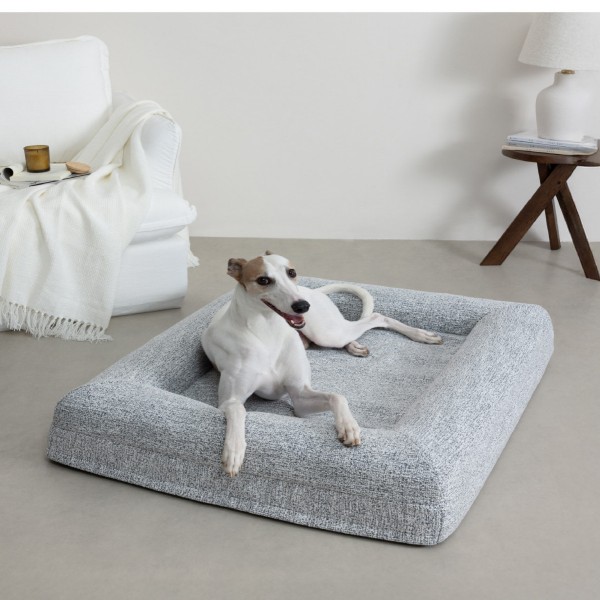
An orthopedic dog mattress should therefore be judged as a load-bearing product, not only as a textile product.
| Comfort Specification | Support Specification |
|---|---|
| Surface texture | Core material |
| Bolster shape | Layer thickness |
| Entry height | Compression under load |
| Temperature feel | Recovery after load |
| Sleeping area | Bottoming-out resistance |
What the Research Actually Supports
Direct research comparing consumer orthopedic dog beds is limited.
A veterinary study compared blankets, a standard mattress, a veterinary memory-foam mattress, and a human memory-foam mattress using pressure sensors. Pressure-relieving supports produced lower contact pressures in key pressure zones than the standard mattress or blanket.
That matters because it shows that support surface design can change pressure distribution.
But the study involved three cadaver dogs and focused on pressure-sore prevention in recumbent veterinary patients.
It does not prove that every consumer memory-foam bed reduces arthritis pain or improves mobility.
That is an important boundary for product claims.
Pressure Relief Is Different From Softness
A support surface can feel soft without distributing pressure effectively.
Likewise, a relatively firm surface may still provide useful support if it spreads load and does not allow the dog to bottom out.
For a large dog, I would evaluate a large orthopedic dog bed alternative with representative load rather than simply pressing the foam by hand.
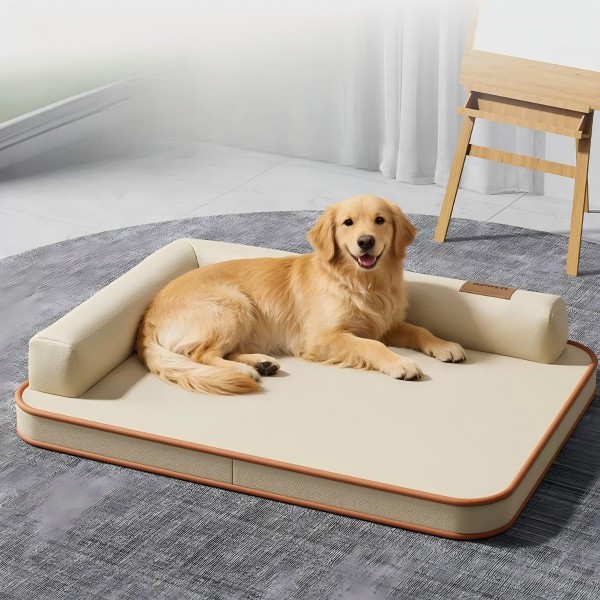
A practical B2B test can ask:
- How deep is the depression under the intended load?
- Does the load reach the hard surface beneath the bed?
- How quickly does the core recover?
- Is recovery still consistent after repeated cycles?
- Does the largest size behave differently from the smallest?
These are product-development questions, not veterinary treatment claims.
Dogs Also Have Comfort Preferences
Comfort is partly behavioural.
A small study of laboratory beagles found that the dogs preferred soft bedding, and elderly dogs used floor-level beds much more than elevated beds. The observed dogs spent much of the night using accessible padded resting areas.
The study was small, so it should not be treated as a universal rule.
But it provides a useful product lesson:
a technically supportive bed can still fail if the dog dislikes the height, temperature, shape, or access.
This is why orthopedic product development cannot be reduced to choosing a foam.
“Memory Foam” Is Not a Complete Specification
Two beds can both use memory foam while behaving very differently because of:
- density
- thickness
- underlying support layer
- cover tension
- dog weight
- ambient temperature
- repeated compression
That is why I would not approve a specification that says only:
“5 cm memory foam orthopedic bed.”
I would want to know how the complete core behaves under load and whether the largest size uses the same construction.
The specification should describe the system, not just the most marketable ingredient.
Bottoming Out Is a Better QC Question
If the dog compresses the bed until very little cushioning remains between the body and the floor, the advertised thickness becomes much less meaningful.
The practical QC question is:
Does the intended dog weight still leave functional support underneath the body?
That question is more useful than “Is this foam soft?”
Body Condition Can Change the Result
The pressure-support study found that contact pressure varied with body condition, with higher maximum pressures in thinner dogs at key contact points.
That is another reason one universal firmness claim is weak.
For retailers, the practical implication is to test more than one representative load condition.
| Test Condition | What It Can Reveal |
|---|---|
| Light load | Surface conformity |
| Medium load | Normal compression |
| Heavy load | Bottoming-out risk |
| Edge load | Edge collapse |
| Repeated load | Shape retention |
| Post-wash test | Construction stability |
These are internal validation steps, not published veterinary standards.
Accessibility Is Part of Comfort
A dog does not experience mattress support if getting onto the bed is difficult.
A veterinary home-modification guide notes that low-access bedding, stable flooring, and avoiding excessive heat retention can make resting areas easier to use.
The product implication is straightforward:
- high decorative walls can reduce accessibility
- a wide entry may matter more than a thicker bolster
- floor grip affects the transition from standing to lying down
- support has to work with the whole bed geometry
That is different from foam quality, but it still affects comfort.
The Evidence Is Stronger for Environmental Support Than Medical Treatment
Veterinary rehabilitation literature supports environmental modifications such as soft bedding and nonslip surfaces, especially for dogs with reduced mobility or recumbency.
A review of canine osteoarthritis rehabilitation notes that many home-care recommendations remain individualized and rely substantially on clinical judgement rather than one evidence-based bedding protocol. Soft bedding is clearly relevant in severely recumbent patients, while broader recommendations remain tailored to the individual dog.
A consumer orthopedic bed can reasonably be described as supportive, cushioned, designed to resist bottoming out, and suitable for support-focused resting.
It should not automatically be described as treating arthritis, relieving chronic pain, correcting hip dysplasia, or speeding recovery.
Support Should Be Tested After Time
Many owner complaints appear months after purchase.
The common failure is permanent compression in the preferred sleeping spot.
A better orthopedic QC plan should therefore include recovery testing.
I would compare original thickness, loaded thickness, immediate recovery, later recovery, and permanent dimensional loss after repeated cycles.
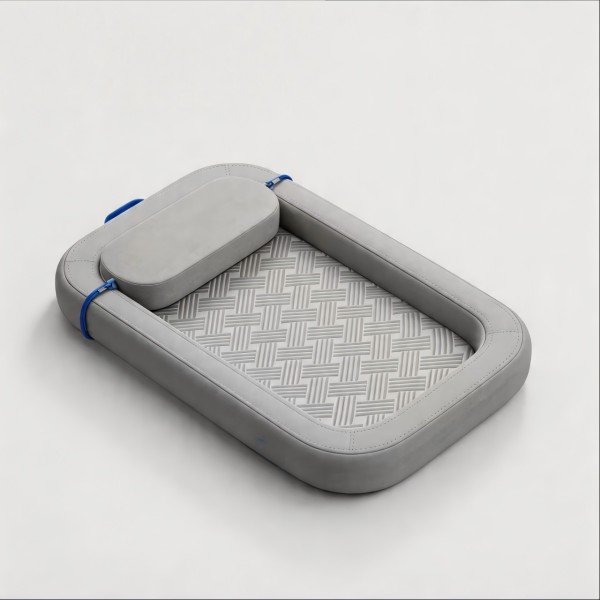
Retailers do not need to publish every internal measurement, but they should know whether the product keeps its support profile over time.
Thermal Comfort Is a Separate Performance Question
A dog may leave a supportive foam bed because the surface feels too warm.
That does not mean the support system failed.
It means thermal comfort failed.
A cooling orthopedic dog bed should therefore treat cooling as a separate function rather than using “breathable” as a substitute for a real mechanism.
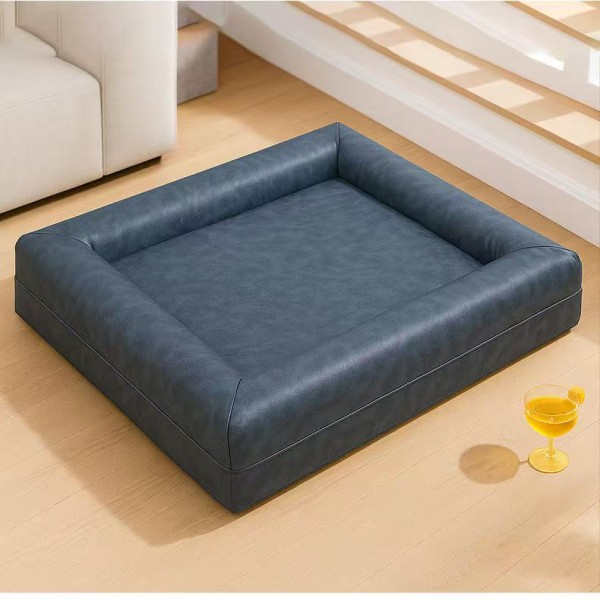
For B2B development, separate support-core performance from cover breathability, moisture handling, surface temperature behaviour, and any real cooling mechanism.
One feature should not be used to imply another.
Washability Can Change the Finished Bed
A useful construction usually separates:
washable cover → protective liner → support core
Routine pet-supply cleaning should follow the material and care instructions.
For product validation, I would wash the actual cover multiple times and re-check fit, shrinkage, zipper operation, seam alignment, liner integrity, and cover tension over the foam.
A cover that becomes too tight after washing can change the feel of the complete bed.
Orthopedic performance should therefore be tested as a system.
A Better Way to Judge Orthopedic Claims
| Claim | Better Verification |
|---|---|
| “Removable washable cover” | Wash test |
| “5 cm memory foam” | Verify layer construction |
| “Non-slip base” | Test on realistic flooring |
| “Resists bottoming out” | Use representative load |
| “Pressure-relieving” | Require relevant product testing |
| “Treats arthritis” | Medical claim requiring clinical evidence |
| “Clinically proven” | Evidence must apply to the actual product |
This is more useful than deciding whether the word “orthopedic” sounds premium.
How Archova Can Turn Support Into a Measurable Specification
At Archova, I would define an orthopedic bed through a repeatable product-validation sheet rather than a marketing description.
The development file should record:
- core materials and layer thickness
- intended dog-weight range
- loaded compression
- post-load recovery
- usable sleeping dimensions
- edge deformation
- entry height
- base grip
- cover wash performance
- liner construction
- thermal function, if claimed
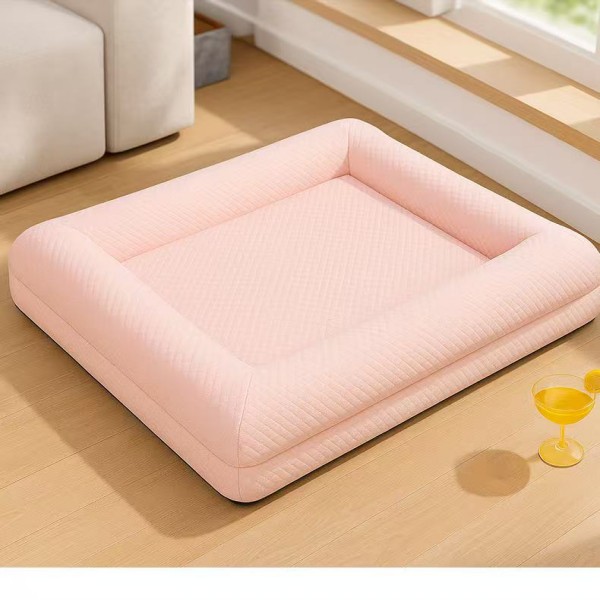
For private-label retailers, those measurements make supplier comparisons more meaningful and help keep bulk production aligned with the approved sample.
The advantage is not simply a stronger orthopedic claim.
It is a product whose comfort and support can be explained in concrete terms.
FAQ
Is there scientific proof that orthopedic dog beds help arthritis?
There is veterinary evidence that supportive and pressure-relieving surfaces can matter in specific clinical and mobility settings. There is not strong evidence that every consumer product labelled “orthopedic” treats arthritis.
Does memory foam automatically make a dog bed orthopedic?
No. The full support system, including material quality, thickness, underlying layers, and behaviour under load, matters.
What does pressure relief mean in a dog bed?
It refers to reducing concentrated contact pressure by distributing load across the support surface. Specific pressure-relief claims should be backed by relevant testing.
Is a softer orthopedic bed better?
Not necessarily. A bed can be very soft and still bottom out. Comfort and structural support should be judged separately.
What should retailers test before approving an orthopedic bed?
At minimum: loaded compression, recovery, bottoming-out risk, usable dimensions, wash performance, floor grip, and sample-to-bulk consistency.
Conclusion
The real value of an orthopedic dog bed is not the label.
It is the combination of comfort the dog will actually choose and support the structure can actually maintain.
The evidence supports a careful conclusion: soft and accessible bedding matters, support surfaces can change pressure distribution, and mobility-focused environments benefit from thoughtful bedding. But the science does not justify turning every memory-foam bed into a medical product.
For pet owners, that means looking past the word “orthopedic.”
For retailers and importers, it means testing the product like a support system—and marketing only what the product can genuinely demonstrate.
References
- Caraty et al. — Comparison of the Different Supports Used in Veterinary Medicine for Pressure Sore Prevention
- Döring et al. — Use of Beds by Laboratory Beagles
- Physiotherapeutic Strategies and Their Current Evidence for Canine Osteoarthritis
- AAHA — Nonpharmacologic Modalities for Pain Management
- VCA — Creating a Comfortable Home for Your Mobility-Compromised Dog
- CDC — About Cleaning and Disinfecting Pet Supplies